



AC Repair in Philadelphia and Nearby Suburbs

Diagnosis first and a price before any work. W.F. Smith, family-owned since 1946.
W.F. Smith technician reviewing AC repair pricing and options with a homeowner beside an outdoor air conditioning unit.

Air Conditioner Repair That Starts With a Clear Answer

When an air conditioner blows warm air, leaks water, freezes up, or will not start, W.F. Smith finds the cause and fixes it. We repair central air conditioners and ductless systems for homes across Philadelphia and nearby Bucks and Montgomery County communities.

A technician diagnoses the cause, explains what it means, and provides the repair price before work begins.

Common AC Problems We Repair

These are the problems Philadelphia homeowners call us about most. The technician confirms the real cause during the visit.

  • Warm air from the vents. Often a failed capacitor, a dirty outdoor coil, a refrigerant leak, or a compressor that is not starting.
  • The outdoor unit hums, but the fan does not spin. Usually a bad capacitor or a stuck contactor, two of the most common AC repairs.
  • Nothing turns on. Check the thermostat and breaker first. A clogged condensate drain can also trip a float switch that shuts the whole system down.
  • Water around the indoor unit. A clogged drain line, a failed condensate pump, a cracked pan, or a coil that froze and is now thawing.
  • Ice on the copper lines or indoor coil. Usually restricted airflow or low refrigerant. Switch the cooling off and let it thaw before the visit.
  • Short cycling or nonstop running. Thermostat and control problems, poor airflow, a low refrigerant charge, or a system sized wrong for the house.
  • A ductless indoor unit flashing a light or dripping water. The flashing pattern is an error code our technicians read. Drips usually trace to the drain or a dirty coil.

Common AC Repairs: Capacitors, Drains, Fans, and Controls

Many AC breakdowns come from small electrical and drainage parts rather than the major components covered further down this page. These are some of the repairs our technicians make most often.
01

Capacitors

The capacitor gives the compressor and outdoor fan motor the boost they need to start. When it weakens, the outdoor unit hums but will not start, or warm air comes from the vents. We test it against its rated value and replace it if it has failed.

02

Contactors

The contactor is the switch that turns the outdoor unit on and off when the thermostat calls for cooling. A worn or stuck contactor can keep the outdoor unit from starting or keep it running nonstop. We check its contacts and control voltage and replace it when needed.

03

Condensate drains and float switches

Your air conditioner pulls moisture out of the air and sends it down a drain line. When that line clogs, water backs up into the pan, and a float switch may shut the whole system off to prevent a leak. We clear the line and check the pan, pump, and switch.

04

Fan motors

The outdoor fan pushes heat away from the condenser, and the indoor blower moves cool air through the house. A failing motor means weak airflow from the vents or an outdoor unit that overheats. We test the motor and its capacitor and replace whichever part has failed.

05

Thermostats and controls

When the system ignores the thermostat, short cycles, or runs at odd times, the cause may be wiring, settings, or a control board. We trace the signal from the thermostat to the equipment to find where it stops.

These parts wear out with use and summer heat. Replacing them is often a same-visit repair when the part is on the truck.

AC Coil Repair

Your air conditioner relies on two primary coils to move heat through the cooling cycle. The evaporator coil, located with the indoor equipment, absorbs heat from the air moving through the system. The condenser coil, located in the outdoor unit, releases that heat outside. When either coil cannot transfer heat properly, cooling performance can suffer.

A coil problem does not always mean the coil itself has failed. Dirt buildup, restricted airflow, a clogged filter, refrigerant loss, drainage problems, or other operating issues can create symptoms that look like a damaged coil. That is why ice on the coil, warm air from the vents, or water around the indoor unit should be treated as symptoms that need diagnosis rather than proof that a coil needs to be replaced.

Signs that may point to a coil or related cooling problem include:

During an AC repair visit, the technician can evaluate airflow, coil condition, refrigerant-system performance, drainage, and the surrounding components before recommending a repair. Depending on the cause, the solution may involve correcting airflow, cleaning a dirty coil, repairing another component, addressing a refrigerant leak when practical, or replacing a failed coil.

When a coil has a significant refrigerant leak or other major damage, the age and overall condition of the air conditioner also matter. On an older system, a major coil repair can be the point where it makes sense to compare the repair with AC replacement rather than automatically investing in one large component. W.F. Smith can explain both paths after the system has been properly diagnosed. A replacement coil also has to match the outdoor unit and its refrigerant, which can limit the options on older equipment.

AC Compressor Repair

The compressor is one of the major components in the outdoor unit. It helps circulate refrigerant through the air-conditioning system so heat can be moved out of the home. Because it plays such an important role, a true compressor failure can be a significant repair. However, several other AC problems can create similar symptoms, so the compressor should be tested before anyone assumes it has failed.

Possible signs of a compressor or related outdoor-unit problem include:

The outdoor unit struggles to start, hums, or repeatedly starts and stops.
The air conditioner appears to be running but the home is not cooling as expected.
A breaker trips when the outdoor unit attempts to start.
New rattling, grinding, buzzing, or other unusual sounds come from the outdoor equipment.
The outdoor unit stops operating while the indoor blower continues to run.

Those symptoms can also come from failed capacitors or contactors, fan-motor problems, electrical supply issues, controls, refrigerant conditions, or other components. Repeatedly resetting a breaker or continuing to run equipment that is struggling to start can create additional problems, so the safer next step is to turn the system off and schedule a diagnosis.

A technician can evaluate the electrical supply, start and run components, controls, outdoor fan operation, refrigerant-system conditions, and compressor performance before determining what actually needs to be repaired. If the compressor itself is confirmed to have failed, W.F. Smith can explain the repair option and what else should be considered before making that investment.

Repair or replace?

For a newer system in otherwise good condition, a compressor-related repair may still make sense. For older equipment, the decision may also depend on the system’s condition, refrigerant type, repair history, equipment compatibility, and the cost of the repair compared with a properly planned replacement. A compressor diagnosis should lead to a repair-versus-replacement conversation when appropriate, not an automatic replacement recommendation. Replacement estimates are free, so you can see both prices before deciding.

AC Recharge and Refrigerant Leak Repair

Refrigerant, often called Freon, moves through a closed circuit in an air-conditioning system. Under normal operation, it is not a fuel that gets used up and periodically needs to be refilled. If the system is low on refrigerant, the important question is why the charge is low. A leak may be present in a coil, refrigerant line, connection, or another part of the sealed system.

Symptoms that can occur when refrigerant charge is low or the refrigerant circuit has another problem include:

  • Cooling that has gradually become weaker or warm air from the vents.
  • Ice on the indoor coil or refrigerant lines.
  • Longer run times or difficulty maintaining the thermostat setting.
  • A home that feels increasingly warm or humid even though the system keeps running.
  • A previous refrigerant recharge that improved cooling only temporarily.

These symptoms are not enough to confirm a refrigerant leak by themselves. Airflow restrictions, dirty coils, controls, and other mechanical or electrical problems can produce similar results. The technician should first evaluate the system and confirm whether refrigerant charge is actually part of the problem.

If a leak is found, the appropriate repair depends on where it is located, how accessible the damaged area is, which component is involved, and the overall condition of the equipment. When a repair is practical, the leak or failed component should be addressed and the system can then be charged correctly as part of the repair. Simply adding refrigerant without addressing the reason it was lost may provide only temporary improvement.

Refrigerant type and equipment age can also affect the decision. On an older system with a major coil leak or another expensive refrigerant-side failure, it may be more useful to compare the repair with AC replacement. W.F. Smith can diagnose the system first, explain what was found, and help you understand the practical options before refrigerant or a major component is replaced.

Many systems installed before 2010 use R-22, which has not been produced in the U.S. since 2020, so recharging them gets harder and more costly each year. R-410A systems can still be serviced and recharged. Under EPA rules, new central air conditioners built since January 1, 2025 use newer, lower-impact refrigerants.

Homeowner using the W.F. Smith website on a smartphone to call for air conditioning repair service.

Quick Checks Before You Call

A few safe checks can help rule out simple problems. Stop at any step that would require opening equipment or working around live electrical components.

  • Set the thermostat to Cool, a few degrees below room temperature. Replace the batteries if the screen is blank.
  • Look at the air filter. Replace it if it is gray or clogged.
  • Check the breaker once. If it trips again, leave it off and schedule service.
  • If you see ice, switch the thermostat from Cool to Off and set the fan to On so the coil can thaw before the visit.
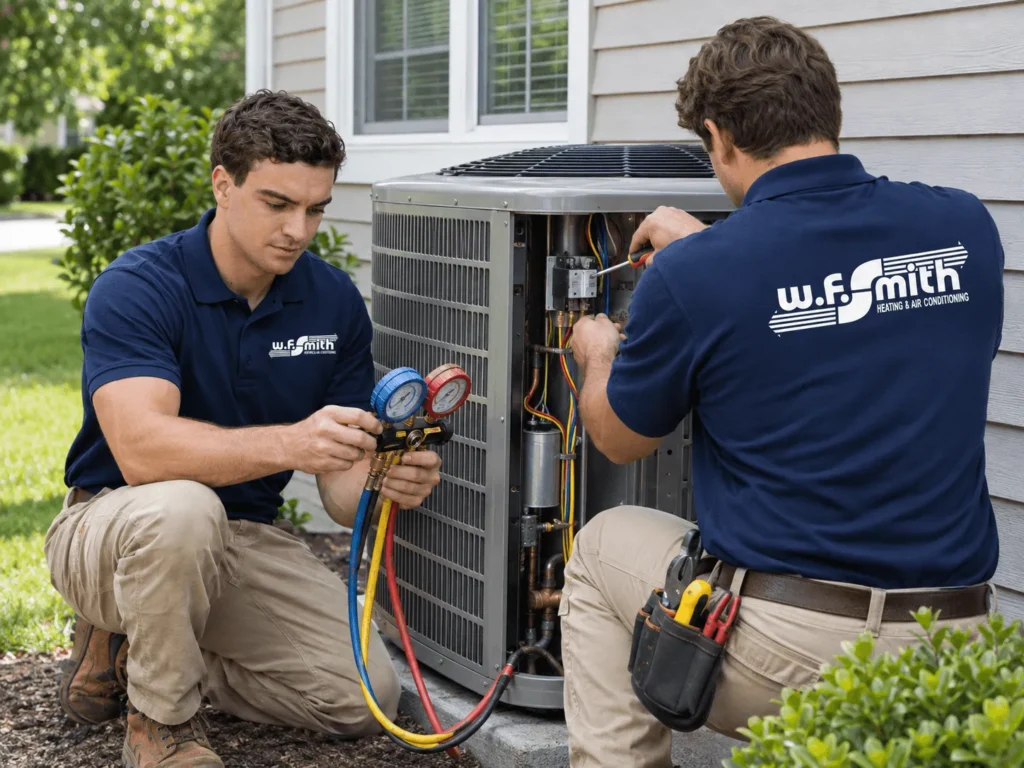
Two W.F. Smith HVAC technicians performing maintenance on an outdoor residential air conditioning unit, checking refrigerant pressure and inspecting electrical components.

What Happens During an AC Repair Visit

  • Book the visit. The office tells you the visit fee before a technician comes out.
  • Make the indoor unit, outdoor unit, thermostat, and electrical panel easy to reach.
  • The technician tests the system and explains what failed and why.
  • You get the repair price before any work starts, and you decide whether to go ahead.
  • We make the repair and test the cooling before leaving. If a part has to be ordered, the office schedules the return visit.

Should You Repair or Replace Your Air Conditioner?

Repair often makes sense when the failed part is manageable and the rest of the system is in good condition. Replacement deserves a closer look when a major component has failed, repairs are becoming frequent, comfort has never been right, or the system is nearing the point where continued investment no longer makes sense.

W.F. Smith can explain the repair option and provide a replacement estimate when you want to compare both paths.

Replacement estimates are free, so getting both numbers costs you nothing.

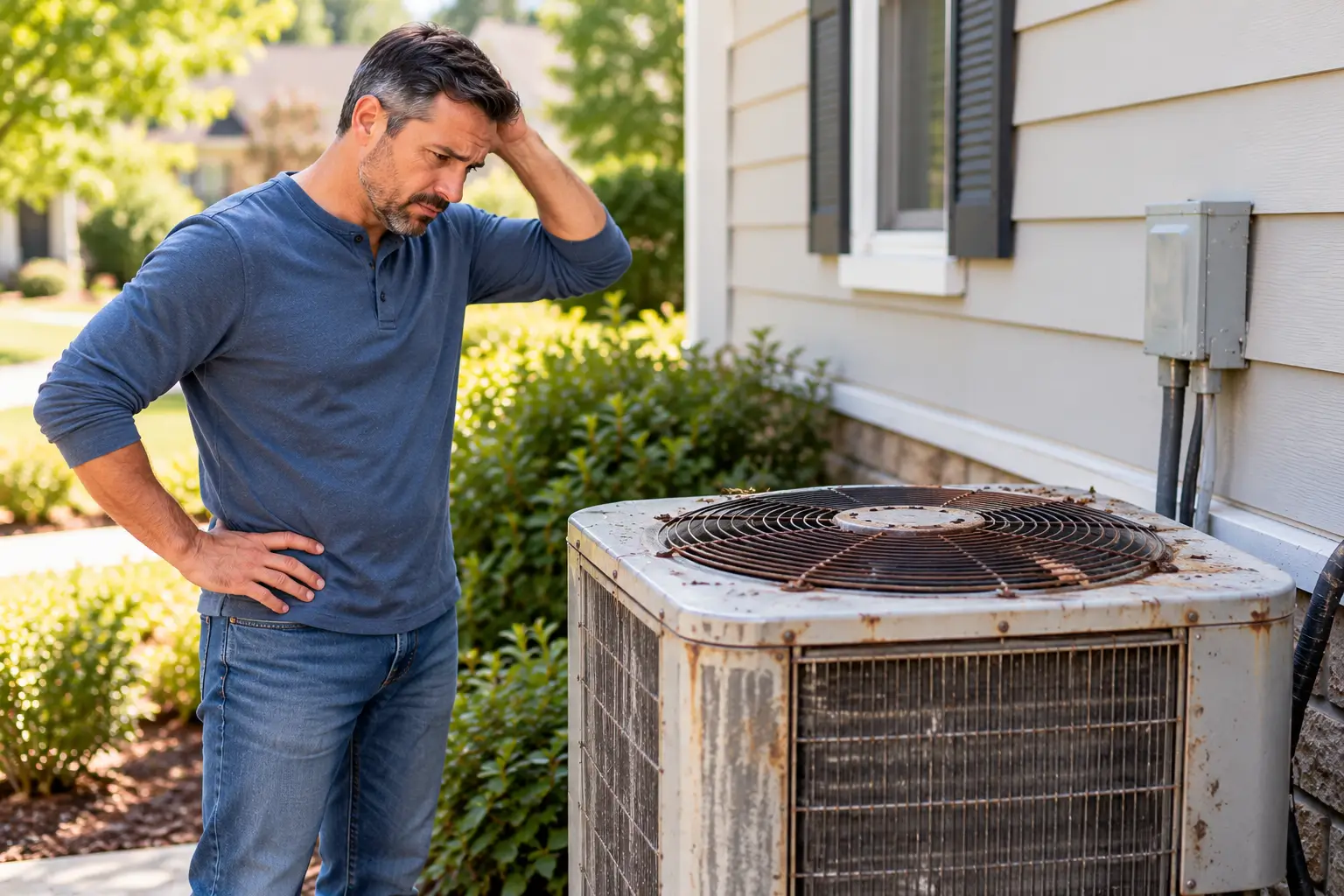
Homeowner considering whether to repair or replace an older outdoor air conditioning unit.
Receptionist answering a customer phone call at a W.F. Smith Heating & Air Conditioning office, with the company logo displayed on the wall behind her.

After-Hours AC Problems

The office answers Monday through Friday, 8:00 a.m. to 4:00 p.m. After hours, an answering service reaches the technician on call. Evening and Saturday visits cost more, and Sundays and holidays cost more again. The technician tells you the rate before coming out.

Call after hours for a burning smell, a breaker that keeps tripping, water damaging a ceiling or floor, or no cooling during dangerous heat with infants, older adults, or anyone with a health condition at home. Other problems can usually wait for a regular weekday visit with the system switched off, which also avoids the after-hours rate.

After the Repair: Keep the System Maintained

A tune-up each spring gives a technician a chance to catch a weak capacitor or a slow drain before it shuts the system down on a hot day. Homeowners who want ongoing service through one program can join the W.F. Smith Maintenance Plan, and plan members get priority when they need emergency service.
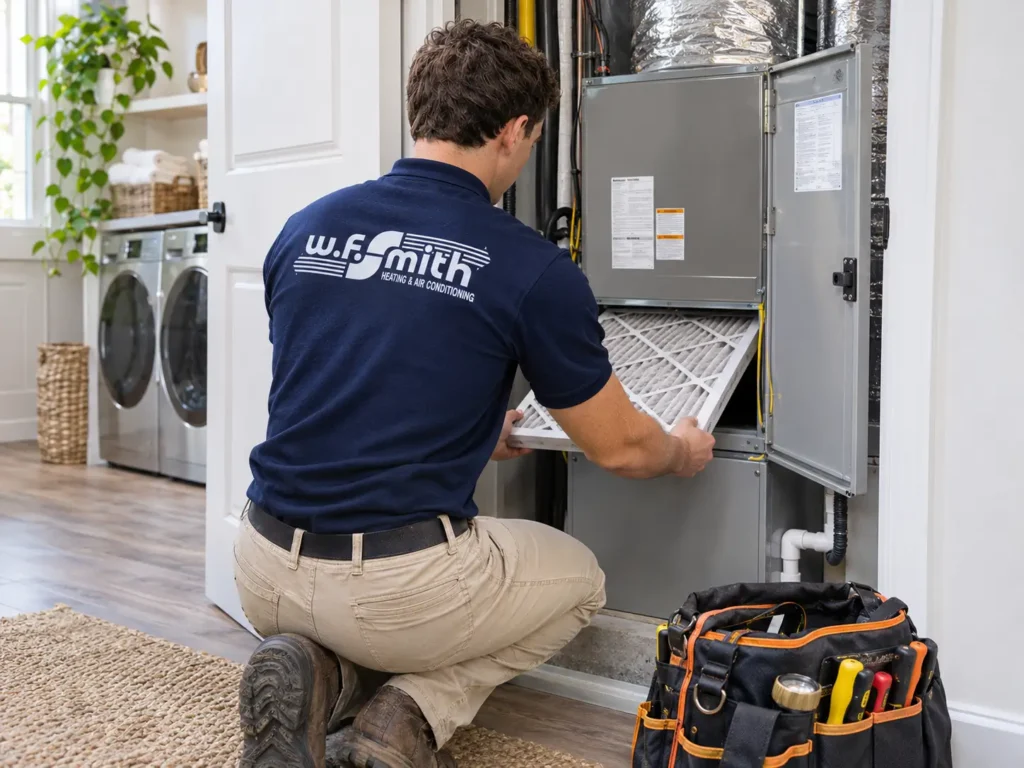
W.F. Smith HVAC technician replacing an air filter in an indoor residential heating and cooling system during preventive maintenance.

Why Philadelphia Homeowners Call W.F. Smith

Family-owned since 1946.

Working from the same State Road shop in Northeast Philadelphia.

Experienced technicians.

Our core technicians average more than 20 years each with the company. You know the cost before any repair begins.

No surprise costs.

You hear the visit fee when you book and the repair price before any work.

Straight repair-or-replace answers.

With the repair price and a free replacement estimate side by side.

What a customer says:

“I chose W.F. Smith based on past experience. Prompt and efficient installation of my last Lennox unit nineteen years ago, and trouble free operation since then until it needed service last month. Equally pleased with this visit.” – Ed S.

AC Repair Questions From Philadelphia Homeowners

Why is my AC running but blowing warm air?

Warm air usually comes from one of four problems: a failed capacitor, a dirty outdoor coil, low refrigerant from a leak, or a compressor that is not starting. A clogged filter can cause it too by choking airflow over the indoor coil. Check the thermostat and filter first. If the air is still warm, the system needs testing, because the symptom alone does not show which part failed.
A humming outdoor unit with a fan that will not spin usually has a failed capacitor or a stuck contactor. Switch the system off at the thermostat and call for service. A compressor that keeps trying to start without help can overheat and damage itself. If the unit hums for a few seconds and then trips the breaker, the compressor may need testing as well.
No. A low charge means refrigerant has leaked out somewhere, because a healthy system never uses it up. A recharge alone restores cooling for a while, and then the charge drops again. The lasting fix is to find the leak, repair it when practical, and then charge the system correctly. On an older R-22 system, a major leak is often a good time to price a replacement.
Most indoor leaks come from the condensate drain. The line clogs with algae and sludge, the pan overflows, or the condensate pump fails. A coil that froze and is now thawing will also drip. Switch the cooling off and look for ice. If water keeps coming, or the system has shut itself off, schedule a repair before the water damages a ceiling or floor.
The office tells you the visit fee when you book, before a technician comes out. After testing the system, the technician explains what failed and gives you the repair price. Nothing gets fixed until you approve that price. If the repair is a large one, you can also ask for a free replacement estimate and compare the two before deciding.
Yes. Our technicians repair ductless mini-splits, and Mitsubishi Electric is the ductless brand we install most often. Common ductless problems include a flashing error light on the indoor unit, water dripping from the indoor head, weak airflow from a dirty filter or coil, and an outdoor unit that will not start. The error code helps the technician narrow down the cause before testing.
Repair it when the system is fairly new and the rest of the equipment is in good shape. Compare replacement when the system is older, uses R-22 refrigerant, or has needed other major repairs. Because the compressor is the most expensive part of an air conditioner, we give you the repair price and a free replacement estimate together, so you decide with both numbers in hand.
Change the filter on schedule, keep about two feet of open space around the outdoor unit, and book a tune-up each spring before the first heat wave. A spring visit catches weak capacitors, slow drains, and dirty coils while they are still small repairs. Watch for new noises, water, or ice, and call early instead of waiting for the system to stop.

Get Your Air Conditioner Running Again