
Home Heating and Cooling, Sized to the House

W.F. Smith has worked on Philadelphia area homes since 1946. License PA003700.
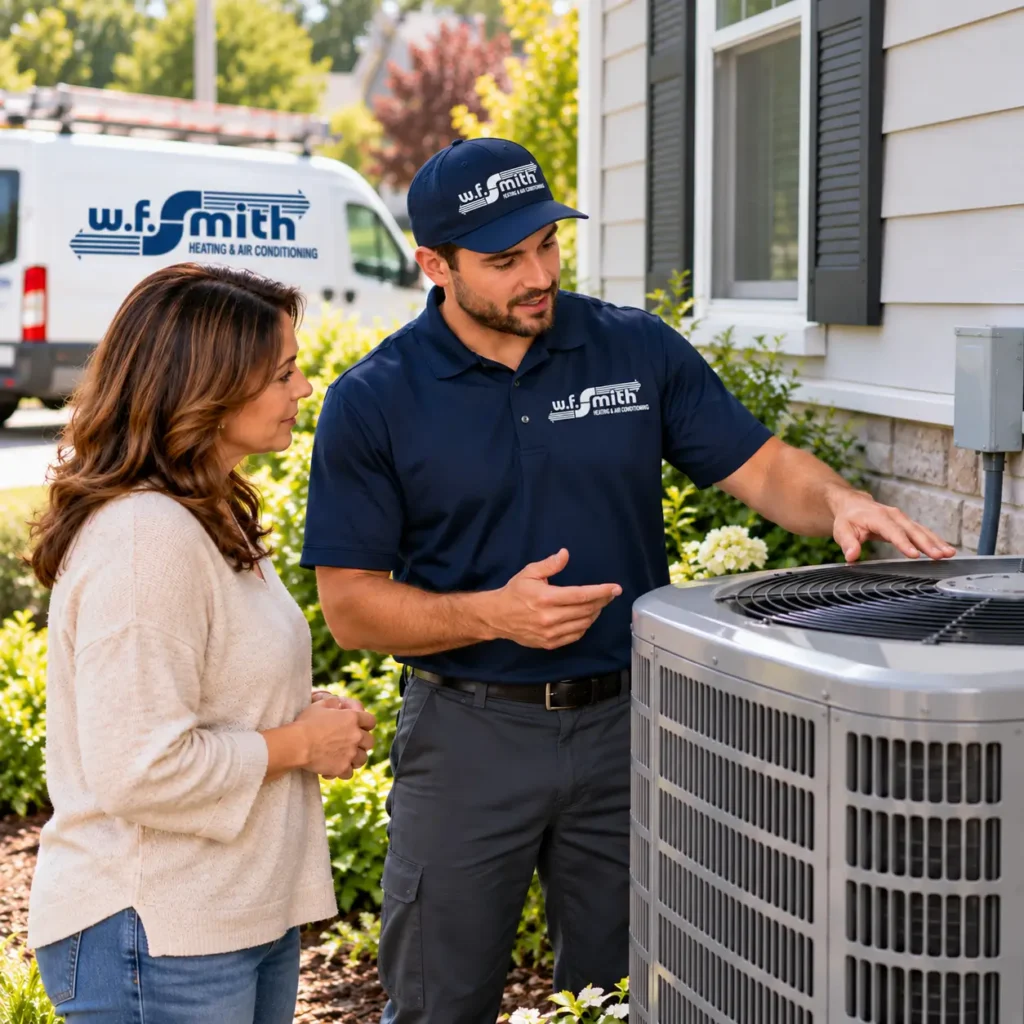
W.F. Smith technician explaining an outdoor air conditioning unit to a homeowner during a residential HVAC service visit.

What We Cover for Homeowners

W.F. Smith covers the whole residential side of the trade: air conditioning, gas furnaces, heat pumps, ductless mini-splits, ductwork, indoor air quality, and maintenance. Whether you need a repair today, a full replacement, or a seasonal check-up, each service has its own page below with the full detail.

Sizing comes before equipment on every install. A real measurement of the building, its insulation, its glass, and the way air travels between floors sets the capacity. Reusing the rating of the unit being removed is quicker, and it repeats whatever was wrong the first time.

We fit Lennox on the ducted side and Mitsubishi Electric on the ductless side, with ClimateMaster where a geothermal loop suits the site. Our technicians service other major brands. Boilers, water heaters, oil systems, and steam systems fall outside our work, and the office says so before a visit is booked.

Signals a Home System Needs a Technician

Most systems warn you first. Six signals come up more than any others.

  • One floor comfortable and another not. Usually duct balance, a missing return, or capacity that never reached the far end.
  • Cool air that still leaves the house sticky. An oversized system satisfies the thermostat before it has pulled the moisture out.
  • The system cycling on and off every few minutes. Short-cycling wears a compressor and a heat exchanger faster than steady running does.
  • Dust settling again days after cleaning. Leaking return duct draws attic and crawl space air in and spreads it around.
  • A burning or musty smell at start-up. Worth a call the same day, because both point at something that gets worse.
  • A utility bill climbing with no change in habits. The system is spending more energy for the same comfort.

Air conditioning

Heating and furnaces

Heat pumps and dual-fuel

Ductless mini-splits

Ductwork

Indoor Air Quality

Maintenance

A cooling tune-up in spring and a heating tune-up in fall catch the faults that otherwise become emergencies. A technician cleans, measures, and tests rather than looking and leaving. Plan members get priority when after-hours calls stack up. Filters need changing every three months, and more often in a house with pets or allergies.

How a Replacement Runs

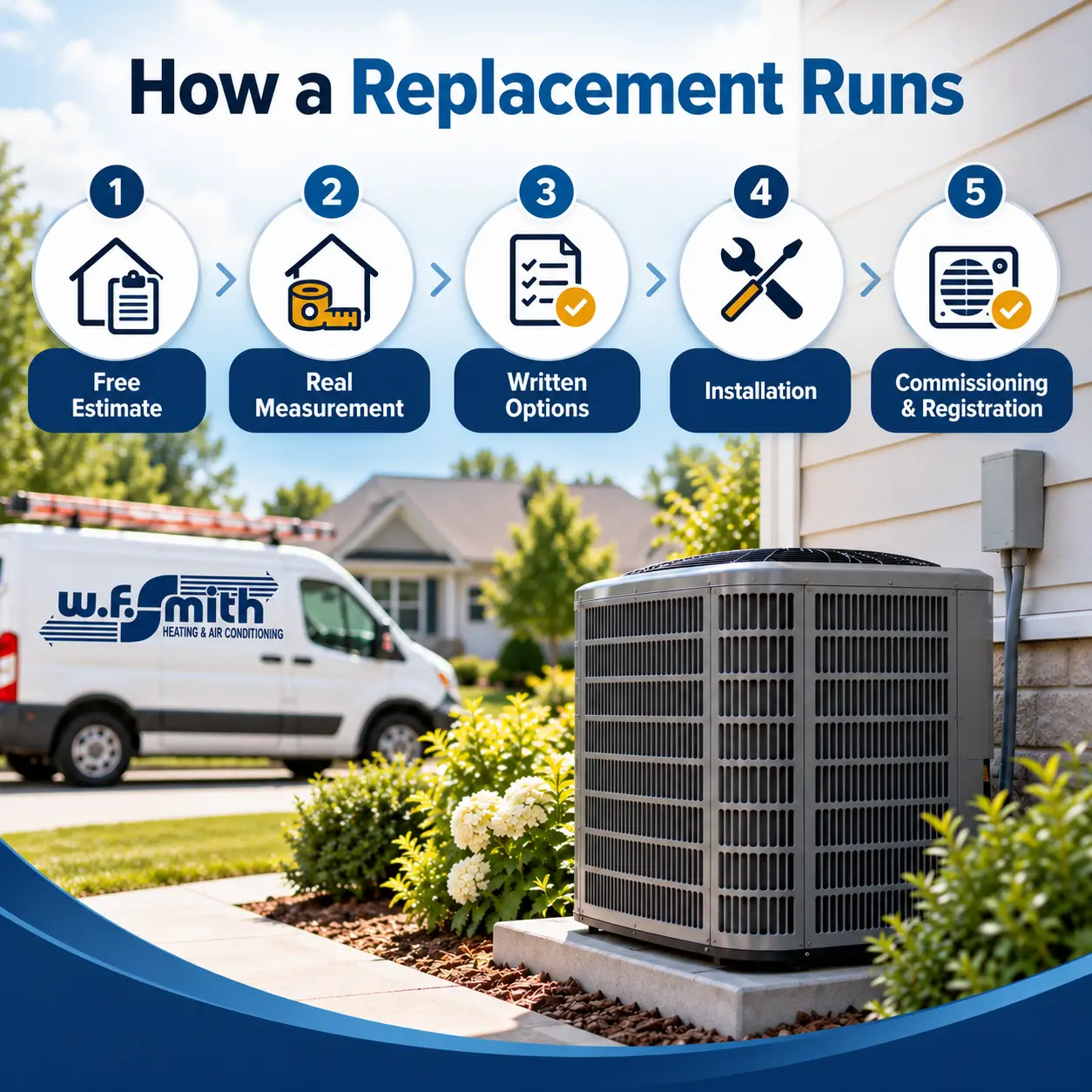
Five steps, and they are the same on every replacement.

  • Free estimate. We walk the house, the existing duct, and the electrical supply.
  • Real measurement. Room-by-room heat gain and loss set the capacity, not the old nameplate.
  • Written options. Two or three systems priced side by side, with the efficiency of each shown.
  • Installation. A straight changeout is usually quick; new duct or a multi-zone layout runs longer.
  • Commissioning and registration. We verify charge and airflow, then register the equipment for its full warranty.
W.F. Smith HVAC replacement process showing estimate, measurement, written options, installation, and system commissioning.

What Affects the Cost of Home HVAC Work

Our office tells you the visit fee before coming out, and that amount never comes off the repair. A replacement estimate costs nothing, real measurement included. Beyond those two, everything else is quoted after a technician has seen the system.

The equipment itself.

Capacity, efficiency level, and whether the job is ducted, ductless, or both.

The state of the duct.

Duct that leaks or runs undersized robs new equipment, and correcting it belongs in the same project.

Access and electrical.

Roof placement, tight basements, and long line runs all add labor.
Rates hold through the year. No heat wave lifts them and no slow October cuts them. Manufacturer rebates and Electrical Association of Philadelphia programs can apply to a replacement, and financing is available for qualifying work.

Why Homeowners Choose W.F. Smith

Family owned since 1946.

The company is owned by the Smith family, who work in the office.

Sizing before equipment.

A real measurement of the house on every install, never the nameplate of the old unit.

A price you approve first.

The fault is found and quoted in writing, and declining stays a real option.

Warranty registration on every install.

Equipment is registered so the factory coverage is live, and parts on service work carry one year.

Home HVAC Questions We Get Asked

What does W.F. Smith cover on the residential side?

Seven areas, and most homes need two or three of them: central air conditioning, gas furnaces, heat pumps and dual-fuel systems, ductless mini-splits, ductwork, indoor air quality, and maintenance. Each has its own page with repair, replacement, and installation detail. Boilers, water heaters, oil systems, and steam systems sit outside our work, and the office will tell you that before a visit is booked.
A heat pump does exactly that, which is why it comes up on most replacement conversations now. It moves heat in both directions, so the same equipment cools in summer and heats in winter, and cold-climate models hold useful capacity well below freezing. A house that already has a gas furnace can run the two as a dual-fuel pair that switches by outside temperature.
Two routes, and the choice usually comes down to what the building will give up. Ductwork can be added, which means finding chases and giving over closet or ceiling space to trunk and branches. Or a ductless system can be fitted, where each indoor head needs only a small wall penetration and a line set to the outdoor unit. We price both when either is workable.
Because the duct decides how much of the equipment you actually receive. A leaking joint in an attic or crawl space dumps conditioned air where nobody lives. Undersized trunk starves the far end of the house, and a missing return leaves a room that cannot exhale. New equipment on that duct still underperforms, so the duct gets inspected during the estimate and any work needed is quoted with it.
Lennox is what we fit most on the ducted side, Mitsubishi Electric on the ductless side, and ClimateMaster where a geothermal loop suits the property. Our technicians service other major brands as well, so an existing system does not have to be replaced to be repaired.
On the cooling side that means washing the outdoor coil, measuring charge and airflow, load-testing the electrical parts, clearing the condensate path, and confirming the thermostat calls correctly. On heating, the burner, ignition, flame sensor, heat exchanger, venting, and safety controls all get checked. Both visits end with measurements rather than an opinion. Filters are separate and need changing every three months.
Often, and it can be a smaller job than people expect. Depending on what a home needs, options like better filtration or added humidity control can sometimes be fitted to equipment that is already working fine. Sealing leaking return duct often helps as much as any of them, since it stops unfiltered attic and crawl space air from entering the system.
Yes, and the commercial side has its own page because the equipment and the scheduling are different. Rooftop units, split systems serving offices and storefronts, and planned replacement work are all covered there. Boilers and steam remain outside our scope on both sides.

Which Type of HVAC System Fits the House?

Get the Whole House Sorted