
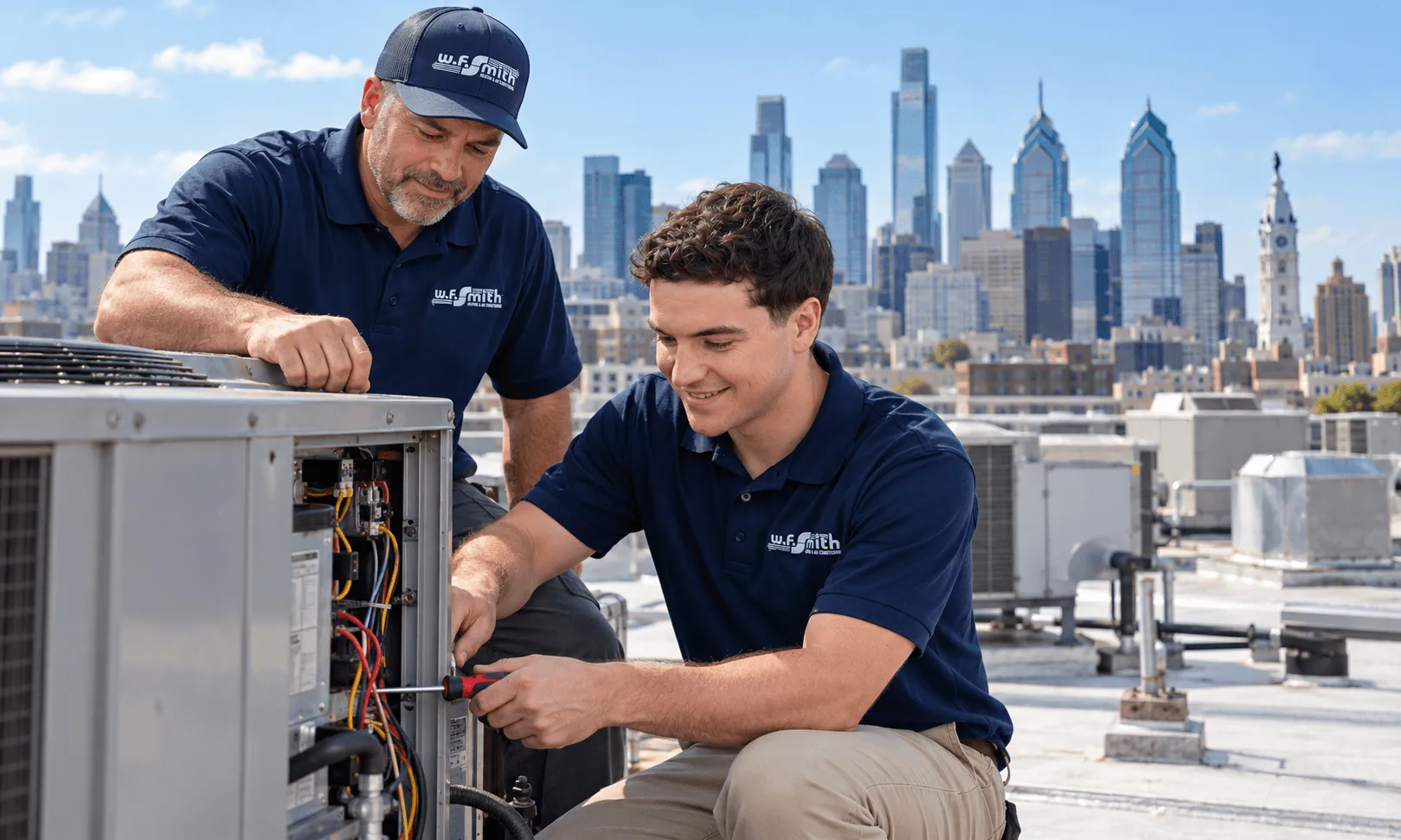
W.F. Smith provides commercial HVAC service across Philadelphia and the nearby Bucks and Montgomery County suburbs. We work with property managers, business owners, restaurant operators, and condominium boards.
Commercial diagnostic visits are quoted per site before a technician is dispatched; unit counts, roof access, and parking affect time on site more than they would at a house. Estimates on replacement equipment are free.
We install Lennox equipment most often and Mitsubishi Electric for ductless and zoned work, and service other major brands. We do not service boilers, water heaters, oil systems, steam systems, or chillers.
Commercial equipment tends to warn a building before it strands it. Tenant complaints are usually the first signal a property manager gets.
Our commercial work covers forced-air equipment and the controls attached to it. Knowing what’s in your mechanical room can save a wasted visit.
The most common commercial call in the area, and the core of what we replace.
Including the duct distribution, economizers, and make-up air tied to them.
Refrigerant-based zoning with ductless cassettes and central controls.
No boilers, no water heaters, no oil systems, no steam systems, and no chillers.
Philadelphia commercial stock includes all five of those excluded categories, so plenty of buildings need a second contractor for part of their system. We say so on the phone rather than billing a visit and walking away.
Which forced-air layout a building has changes a lot about how a repair goes. A packaged rooftop unit carries the compressor, condenser, evaporator coil, blower, and gas heat section in one cabinet bolted to a curb, so every visit happens on the roof and weather reaches every component in it. A commercial split system separates the outdoor condenser from an indoor air handler, which keeps the blower and evaporator coil out of the weather but adds a refrigerant line set that gives a leak more places to start.
This page is the front door for our commercial service pages, each covering the equipment detail, cost drivers, and questions specific to it.
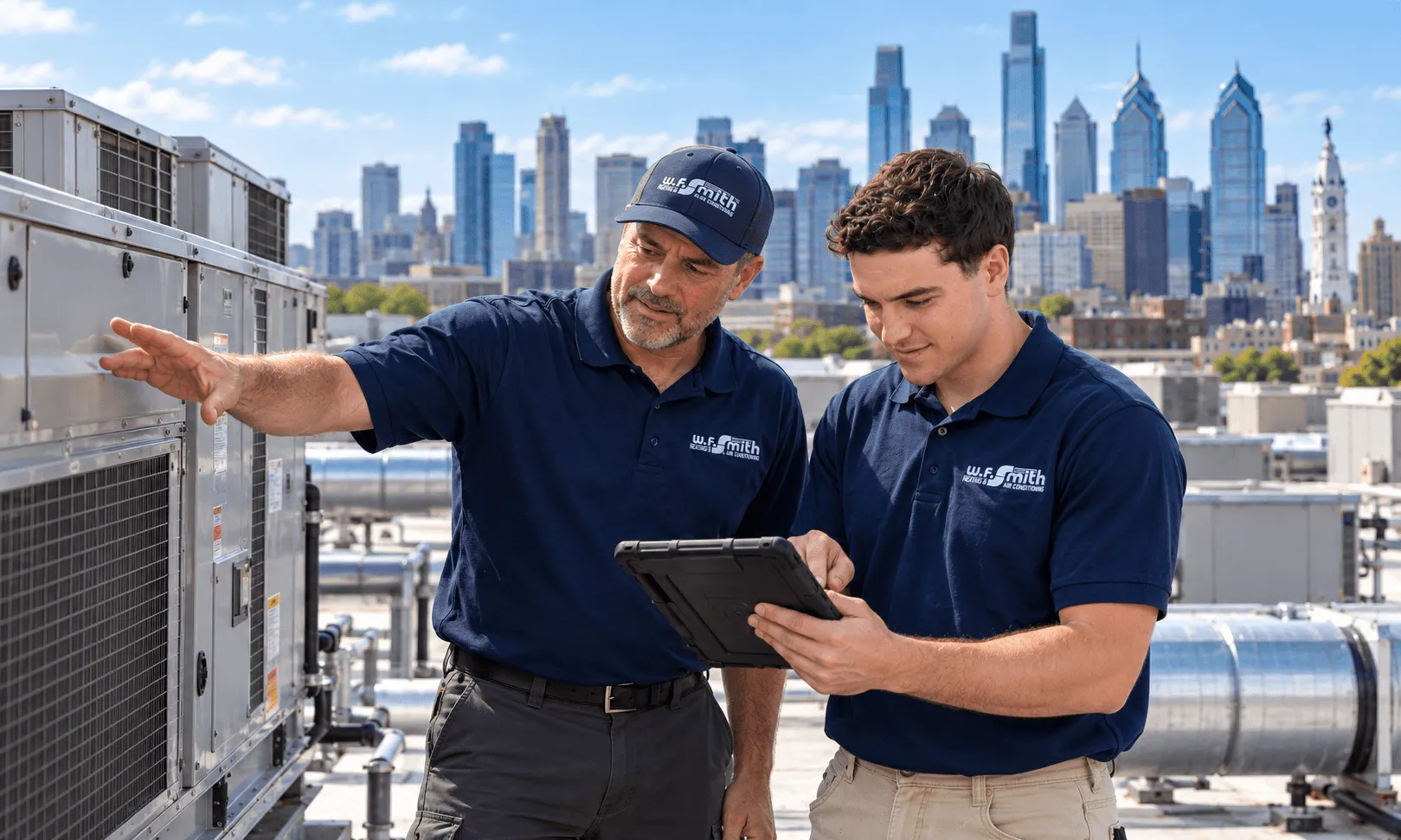
We size replacement equipment on a load calculation, not the nameplate of the unit coming out. A fit-out, a tenant change, or new glazing can shift the real load.
Oversizing is a common mistake in commercial buildings:
Undersizing is easier to spot: the equipment runs without a break and still loses setpoint by mid-afternoon.
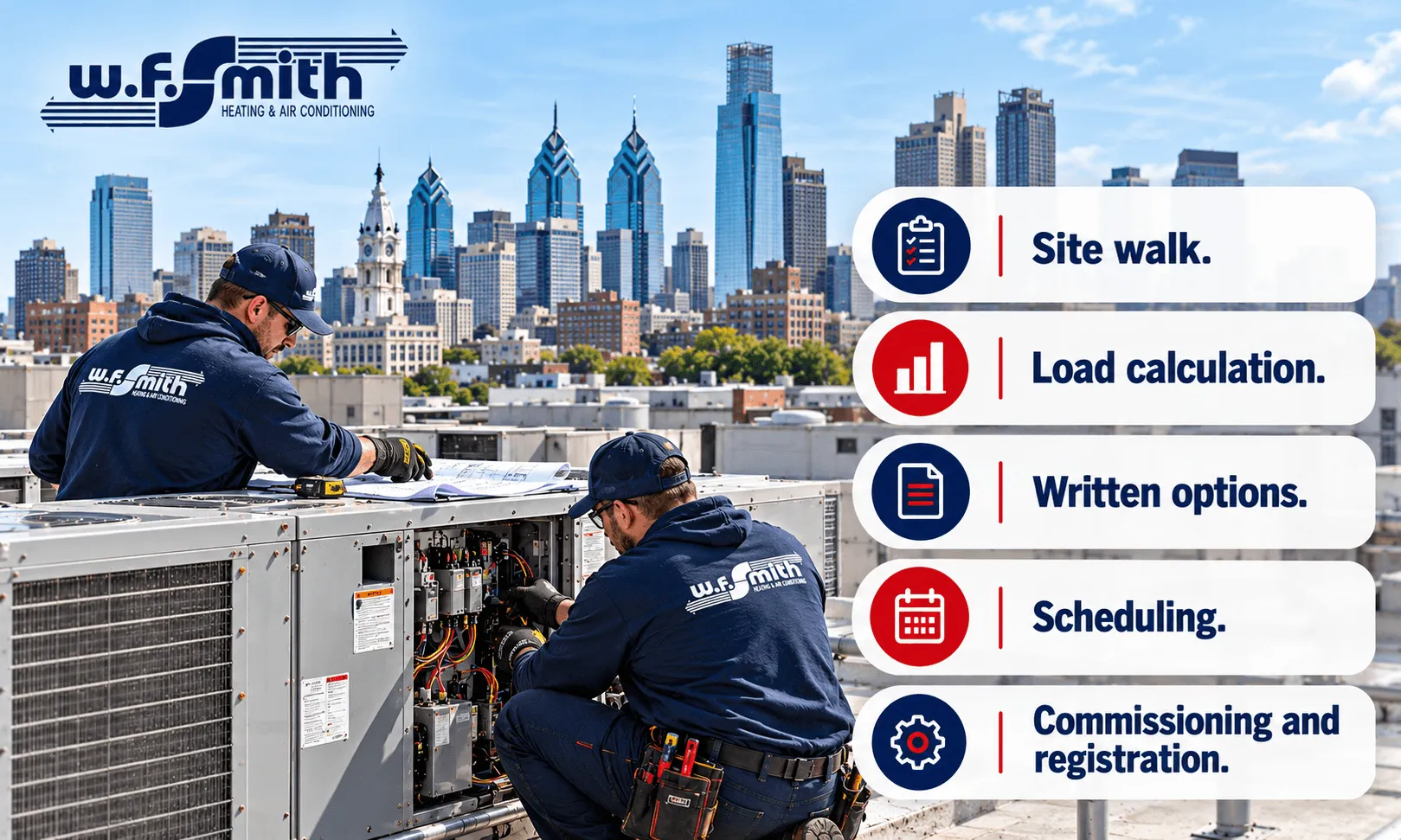
Commercial diagnostic visits are quoted per site before a technician is dispatched. The fee runs higher than our residential visit, since commercial access and equipment take longer.
Estimates on replacement equipment are free. We quote repair and replacement work after seeing the site, not over the phone.
Crane time, hatch access, and loading restrictions can add real labor, especially in Center City.
Older refrigerants have grown more expensive as supply has wound down, which affects the cost of any recharge.
New equipment on a failing curb or leaking duct rarely performs well, so that work becomes part of the job.
Rates hold steady through the season. Manufacturer and Electrical Association of Philadelphia rebates can apply to qualifying replacement projects, and financing is available for qualifying work.
Not a rule of thumb, and not the tonnage on the old nameplate.
You get the fault named and the price in writing before anything is opened up.
Our rates do not change with the weather.
The Smith family runs the company from 7310 State Road.
Yes. Commercial HVAC has run alongside the residential side of this business since 1946. Clients include offices, retail, restaurants, apartment buildings, condominium associations, and data centers across Philadelphia, Bucks County, and Montgomery County. Our five owners share more than 140 years in the trade.
We do not service boilers, water heaters, oil systems, steam systems, or chillers. Older Philadelphia commercial buildings often heat from a central steam or hydronic plant, and some larger properties cool from a chiller, so a second contractor covers that side. We’ll say so on the phone when you describe your equipment.
Commercial diagnostic visits are quoted per site before a technician is dispatched, and no flat rate is posted. The fee runs higher than our residential visit, since unit counts, roof access, and parking affect time on site. Estimates on replacement equipment are free.
Uneven temperature across a floor is often distribution rather than capacity. A failed damper, a stuck economizer, or a rooftop unit running on only one of two stages can all produce the same complaint. A technician checks staging, damper position, and supply air temperature before quoting anything.
It depends on comparing the repair cost against the age and condition of the unit, since commercial rooftop equipment commonly runs 15 to 20 years with maintenance. A capacitor, contactor, belt, or fan motor is often worth replacing at almost any age; a compressor or coil failure on an older unit is a different conversation. You get both numbers in writing before deciding.
Yes. An answering service reaches the on-call technician once our office closes at 4:00 p.m. After-hours and Saturday work bills at overtime rates, and Sundays and holidays bill higher again. The technician quotes that rate before coming out. Larger changeouts get booked around your operating hours instead.
Yes. VRV and VRF zoning systems feed several indoor units from one outdoor condenser and can heat one zone while cooling another. They suit offices, mixed-use floors, and older Philadelphia buildings with no room for large duct runs. Mitsubishi Electric is the equipment we install most often on the ductless and zoned side.
Commercial HVAC work changes with how the building is used. Offices need predictable comfort during occupied hours, restaurants carry higher internal heat loads, multifamily buildings require coordinated access, and retail or mixed-use properties often need work scheduled around customers and tenants. W.F. Smith plans the service window, access, and approval path before the job starts so the HVAC work fits the building’s operation.
Call (215) 273-3901 to book commercial service, or to arrange a free estimate on replacement equipment. Our office answers Monday through Friday, 8:00 a.m. to 4:00 p.m. Outside those hours an answering service reaches the technician on call.