Furnace Thermostat Not Working? Start With These Checks
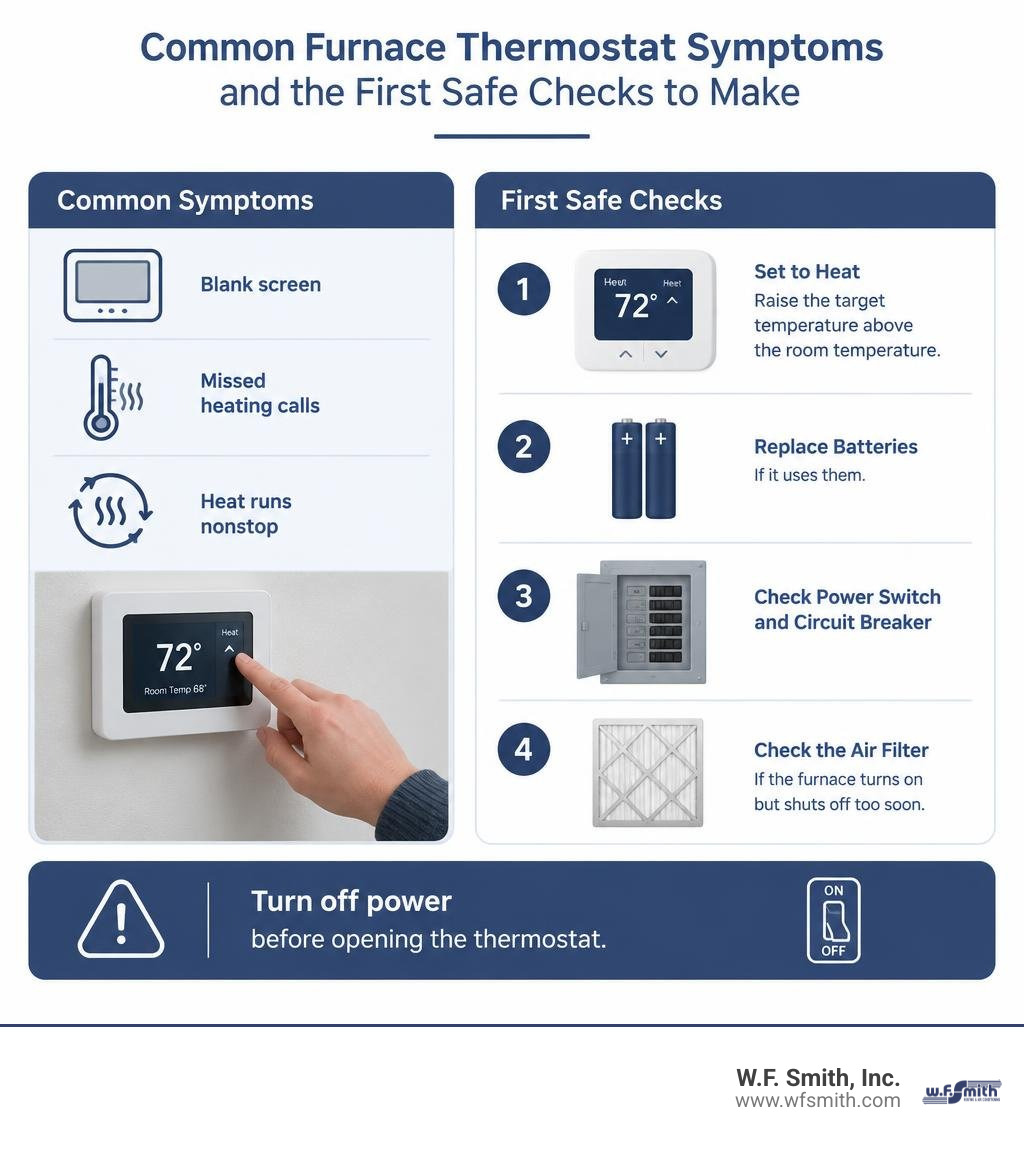
Before you pay for furnace thermostat repair, check the simple causes. Set the thermostat to Heat and raise the target temperature above the room temperature. Replace its batteries if it uses them, then check the furnace power switch and circuit breaker. If the furnace turns on but shuts off too soon, check the air filter.
A blank screen, missed heating calls, or heat that runs nonstop can point to the thermostat, but they can also signal a furnace or power problem. Turn off power before opening the thermostat. If these checks don’t help, an HVAC technician can find the cause without guessing at the wiring.
Common Signs Your Heating System Needs Furnace Thermostat Repair
When the temperatures drop across the Delaware Valley, you rely on your heating system to keep your home comfortable and safe. The thermostat serves as the central brain of this setup, translating your temperature preferences into signals that fire up your equipment. However, when communication breaks down, it can leave you shivering in your living room or dealing with skyrocketing utility bills.
Many thermostat symptoms have simple causes that homeowners can check safely before scheduling service. When basic troubleshooting does not restore reliable heat, prompt furnace repair can help identify the underlying equipment issue.
For practical advice on choosing help before cold weather arrives, see our guide to finding reliable Philadelphia heating repair before winter.
Blank or Unresponsive Digital Display
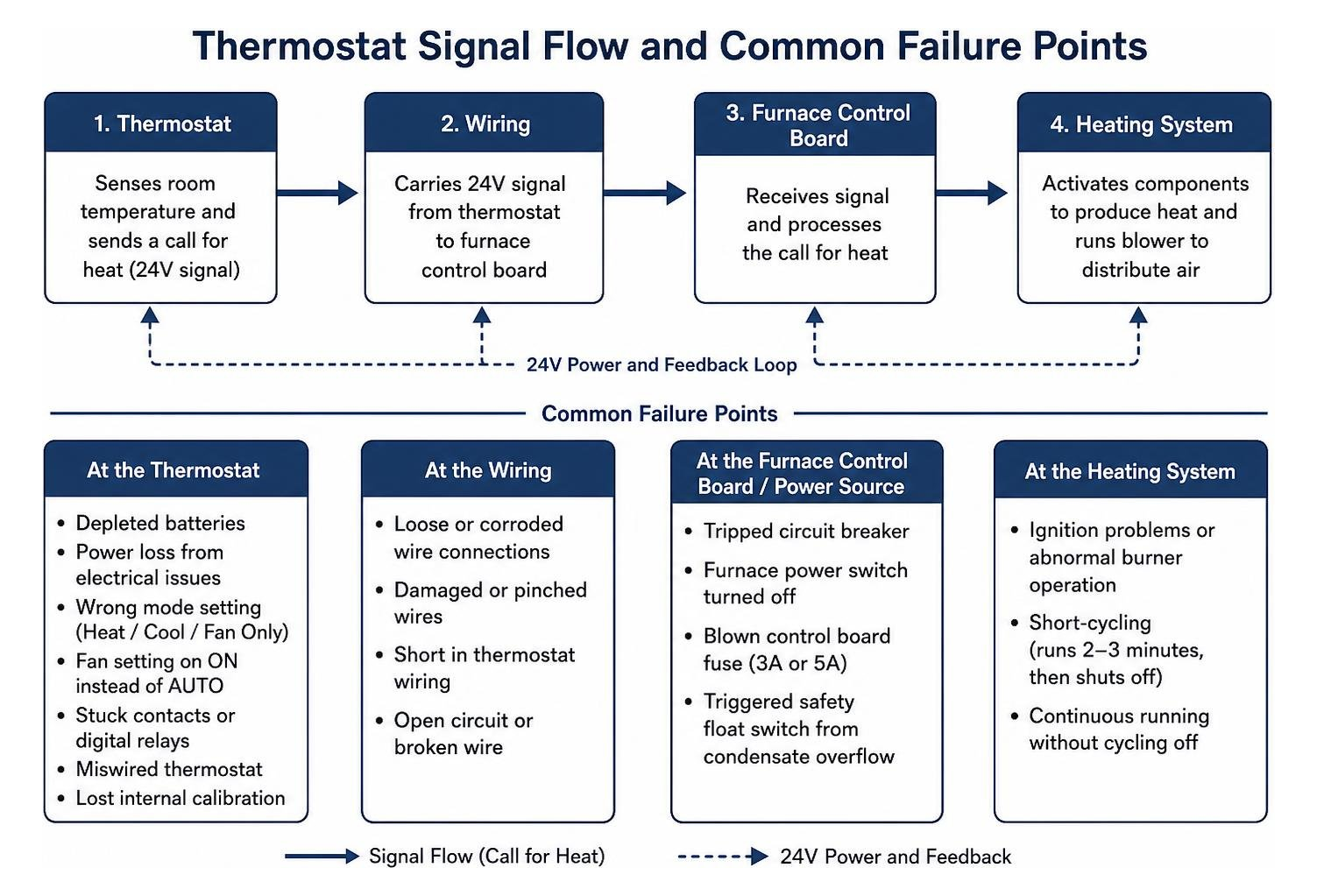
A completely black screen on a digital or smart thermostat is one of the most frequent service complaints we see. In many cases, the unit has simply lost its primary source of power. If your thermostat runs on standalone batteries, depleted alkaline cells are the most likely culprit.
If replacing the batteries does not bring the display back to life, the problem often lies within your home’s electrical circuitry:
- Tripped Circuit Breakers: A power surge can trip the dedicated breaker serving your indoor heating equipment, cutting off low-voltage power to the control interface.
- Furnace Power Switch: Most indoor units feature an exterior power switch that resembles a standard light switch. If this was accidentally toggled off during cleaning or storage organization, the thermostat will lose power.
- Blown Control Board Fuse: Just like an automobile, your furnace’s internal control board utilizes a low-voltage blade fuse (commonly 3-amp or 5-amp) to protect delicate circuitry. A short in the thermostat wiring can blow this fuse instantly.
- Triggered Safety Float Switches: In split systems, an overflowing condensate drain pan will activate a safety float switch, immediately cutting the 24-volt circuit to protect your home from water damage.
For model-specific instructions, consult the thermostat manufacturer’s manual. If the display remains unresponsive after basic power checks, our HVAC team can test the controls and wiring safely.
Furnace Won’t Turn On or Runs Constantly
If your thermostat display looks fully functional but adjusting the temperature produces zero response from your furnace, you are facing a communication failure. Verify first that the thermostat is firmly set to “Heat” rather than “Cool” or “Fan Only,” and confirm that the setpoint is at least 3 to 5 degrees higher than the current ambient room temperature.
On the other end of the spectrum is a system that runs constantly without cycling off. This continuous operation can happen when:
- The internal mechanical contacts or digital relays inside the thermostat become stuck in the closed position, transmitting a nonstop heating command.
- The thermostat’s fan setting is toggled to “ON” rather than “AUTO,” causing the blower motor to run continuously even when the heating burners have turned off.
- The thermostat is miswired or has lost its internal calibration.
When continuous heating occurs alongside gas-specific symptoms, such as unusual ignition noises or burner abnormalities, it is safest to schedule specialized gas furnace repair with a certified technician.
Short-Cycling and Inaccurate Room Temperatures
Short-cycling occurs when your heating equipment starts up, runs for just two or three minutes, and abruptly shuts down before reaching the programmed temperature setpoint. This rapid cycling subjects the blower motor, ignitor, and control relays to severe mechanical stress while leaving your rooms unevenly heated.
Thermostats can trigger short-cycling due to several environmental and mechanical factors:
- Sensor Drift and Miscalibration: Over years of operation, internal thermistors can degrade, causing the device to read the room temperature as significantly warmer than it actually is.
- Poor Wall Placement: Thermostats installed in direct sunlight, directly above supply heat registers, or near heat-generating appliances like ovens will heat up prematurely and turn the equipment off before the rest of the house warms up.
- Draft Interference: Unsealed wall cavities behind the thermostat mounting plate can allow cold drafts from interior wall framing to hit the internal sensor, creating erratic cycling behavior.
- Restricted Airflow: A severely dirty air filter restricts system airflow, trapping heat inside the furnace cabinet. This triggers the high-limit safety switch to shut down the burners, a condition often mistaken for thermostat malfunction.
Scheduling seasonal furnace maintenance ensures your system airflow, sensors, and safety limits are properly tuned to avoid false short-cycling issues.
How to Tell If You Need Furnace Thermostat Repair or Equipment Service
Determining whether the root problem lies within the thermostat on the wall or deep inside the mechanical furnace cabinet is straightforward when you know what to check.
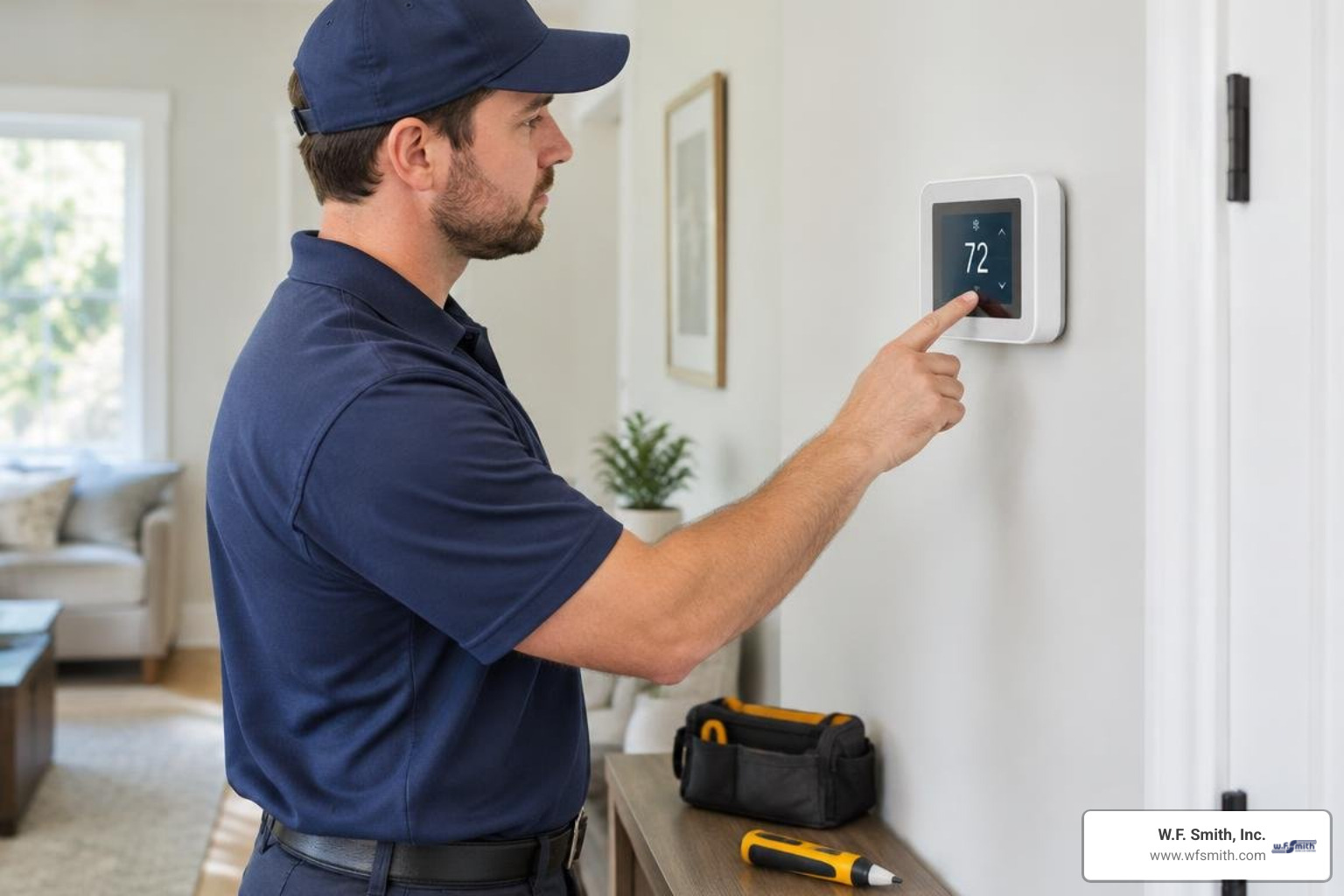
Start by observing the thermostat screen when you raise the target temperature. Modern digital units display an active heating indicator, such as a flame icon, blinking status light, or a clear “Heat On” message. If this icon appears and you hear an audible click from the thermostat’s internal relay, the device is successfully sending a 24 VAC call for heat down the wiring harness.
If that heating call is present but nothing happens at the furnace, the failure is almost certainly located inside the heating unit itself. Common furnace-side culprits include:
- A dirty flame sensor that fails to detect burner ignition, shutting off gas flow after four seconds.
- A failed hot surface ignitor that cannot light the incoming gas supply.
- A faulty draft inducer motor or blocked flue pipe tripping the pressure switch.
- A failed blower motor capacitor preventing warm air circulation.
When equipment diagnostics point past the wall interface, contacting a licensed technician for heating repair prevents unnecessary component guesswork.
Step-by-Step DIY Troubleshooting for Common Thermostat Issues
Before scheduling a service appointment, performing a structured diagnostic workflow can often restore heat quickly. Homeowners can safely perform these foundational HVAC troubleshooting steps using basic household tools.
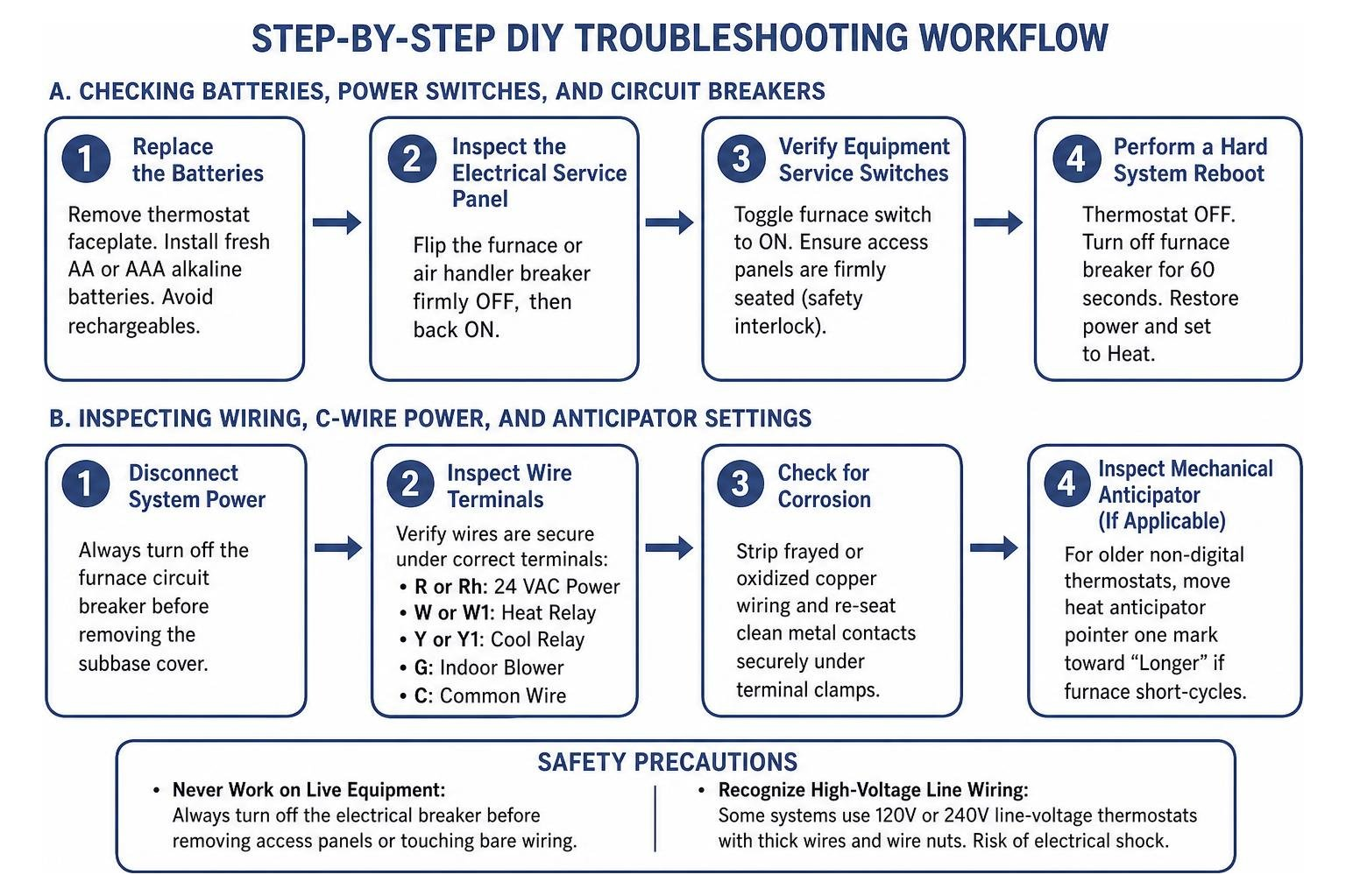
Checking Batteries, Power Switches, and Circuit Breakers
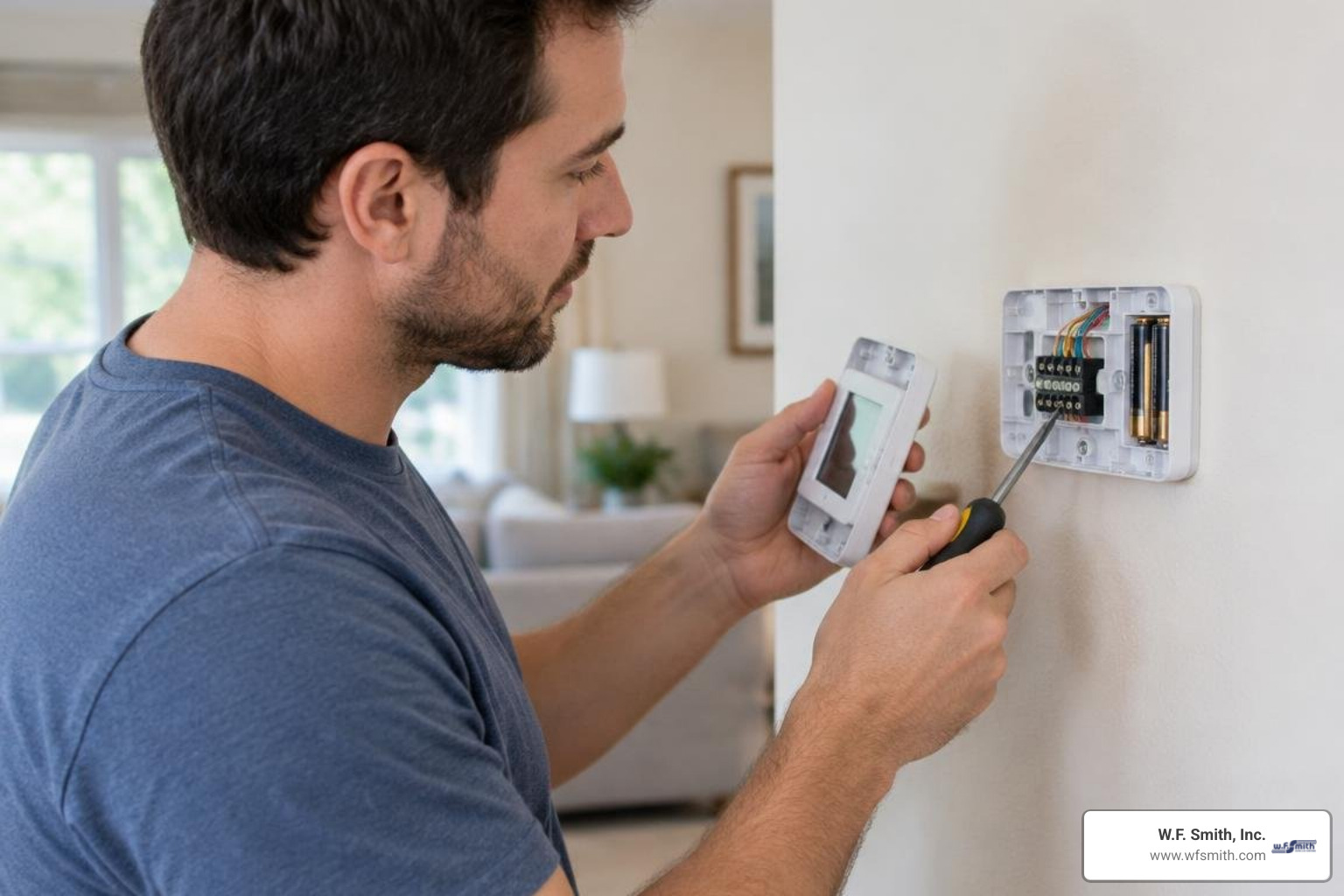
- Replace the Batteries: Remove the thermostat faceplate from its wall subbase. Install fresh, high-quality AA or AAA alkaline batteries. Avoid using rechargeable batteries, as their lower nominal voltage can cause erratic digital sensor operation.
- Inspect the Electrical Service Panel: Locate the circuit breaker labeled for your furnace or air handler. Even if the breaker switch does not look tripped, flip it firmly to the full “OFF” position and then snap it back to “ON.”
- Verify Equipment Service Switches: Walk to your indoor furnace unit and confirm that the external toggle switch is flipped up to “ON.” Ensure that the main blower compartment door and burner access panels are firmly seated; modern furnaces have a built-in safety interlock switch that cuts all electrical power if a panel is loose.
- Perform a Hard System Reboot: Turn the thermostat completely to “OFF.” Switch off the furnace breaker for 60 seconds to clear residual processor memory in modern communicating equipment, then restore power and set the thermostat back to “Heat.”
Inspecting Wiring, C-Wire Power, and Anticipator Settings
If basic power checks fail to solve the issue, inspect the low-voltage terminal connections behind the wall plate:
- Disconnect System Power: Always turn off the furnace circuit breaker before removing the subbase cover.
- Inspect Wire Terminals: Verify that each individual wire lead is firmly anchored under its corresponding terminal screw. Standard residential wiring conventions use specific terminal letters:
- R or Rh: 24 VAC Power Supply
- W or W1: Heating Control Relay
- Y or Y1: Cooling Compressor Relay
- G: Indoor Blower Fan Relay
- C: Common Wire (provides constant 24 VAC return path for Wi-Fi and smart thermostats)
- Check for Corrosion: Strip away any frayed or oxidized copper wiring and re-seat clean metal contacts securely beneath the terminal clamps.
- Inspect Older Mechanical Anticipators: If your home uses an older non-digital mechanical thermostat, it features a small adjustable pointer disc known as a heat anticipator. If the furnace short-cycles, gently move this pointer one calibration mark toward the “Longer” setting using the tip of a pencil.
If you discover loose terminals, frayed connections, or missing low-voltage power, our team provides furnace thermostat repair to safely restore proper electrical signaling.
Safety Precautions Before Furnace Thermostat Repair and Troubleshooting
While low-voltage thermostat circuits operate at a nominal 24 volts AC, safety precautions remain essential:
- Never Work on Live Equipment: Always turn off the electrical breaker before removing access panels or touching bare wiring.
- Recognize High-Voltage Line Wiring: Standard central furnaces utilize 24-volt low-voltage controls, but certain baseboard heating systems utilize 120-volt or 240-volt high-voltage line thermostats. High-voltage units feature thick wires connected with twist-on wire nuts. Touching line-voltage wiring carries severe risk of electrical shock.
- Never Bypass Built-In Safety Controls: Do not attempt to bypass furnace safety switches, roll-out sensors, or high-limit controls with temporary jumper wires. These components protect your home from fire and carbon monoxide exposure.
Repair vs. Replacement: Making the Right Choice for Your Home
Most residential digital and programmable thermostats deliver an operational lifespan of 10 to 15 years. Over time, internal circuit boards degrade, display segments fail, and temperature sensors lose factory calibration. Deciding whether to repair your existing unit or replace it comes down to equipment age, repair costs, and system compatibility.
Furnace Thermostat Repair Costs vs. Upgrading to Smart Controls
When evaluating whether to invest in repairs, compare the estimated repair cost against the price of an equipment upgrade. A solid rule of thumb: if the repair estimate exceeds 50% of the cost of a modern replacement, upgrading is usually the smarter financial move.
If a replacement becomes the better option, our furnace and air conditioner replacement cost guide explains the factors that affect a home comfort upgrade.
| Service Option | Typical Cost Range | What It Covers | Best Suited For |
|---|---|---|---|
| Standard Diagnostic Visit | $200 – $300 | Complete electrical and signal testing by a licensed technician | Pinpointing unknown heating breakdowns |
| Basic Thermostat Repair | $50 – $100 | Battery replacement, subbase terminal tightening, cleaning contacts | Minor mechanical and connection issues |
| Complex Wiring & Sensor Repair | $200 – $300 | C-wire installation, wall-plate rewiring, remote sensor fixes | Resolving erratic cycling and power drops |
| Standard Programmable Replacement | $200 – $500 | Unit cost and full professional installation/configuration | Replacing aging manual/digital units on basic systems |
| Smart Thermostat Upgrade | $750 – 975 | Advanced Wi-Fi hardware, C-wire adaptation, mobile app setup | Homes seeking remote control and energy savings |
When planning an upgrade, local electric and gas utilities often offer instant rebates for qualifying smart thermostats, helping offset hardware costs. While Section 25C federal energy credits applied to qualifying HVAC systems placed in service through 2025, they are no longer available for installations completed after December 31, 2025. Modern efficiency savings now center around local utility rebates, manufacturer seasonal promotions, and ongoing energy reductions.
When to Replace an Aging or Incompatible Unit
There are several scenarios where replacing your thermostat is clearly preferable to attempting repairs:
- Persistent Sensor Inaccuracy: If the thermostat continuously misreads ambient room temperature by more than 4 degrees despite recalibration, internal sensor degradation is irreversible.
- Upgrading to High-Efficiency Multi-Stage Equipment: Advanced two-stage furnaces and variable-speed blowers require multi-stage or communicating thermostats to regulate output properly. An older single-stage thermostat will force modern multi-stage heating equipment to operate like a basic on-off unit, wasting energy.
- Frequent Component Breakdowns: If an older unit repeatedly drops programming or loses relay connectivity, internal microprocessors are nearing end-of-life.
If your heating system as a whole is reaching the end of its useful lifespan, pairing a new smart control interface with a modern furnace replacement delivers balanced airflow, lower utility bills, and consistent indoor comfort.
Frequently Asked Questions About Furnace Thermostats
Can I install and calibrate a new thermostat myself?
While basic battery-powered, single-stage thermostats can be installed by experienced DIYers, smart thermostats often introduce complications. Modern units require a dedicated Common Wire (C-wire) to provide continuous 24 VAC power for Wi-Fi transmitters and backlit touchscreens. Miswiring these terminals can short-circuit the low-voltage transformer or destroy the main furnace control board.
For complex multi-stage systems, variable-speed equipment, or split systems, scheduling professional heating services guarantees correct terminal assignments and proper system staging.
Why does my thermostat click but the furnace fails to ignite?
The audible “click” inside your thermostat indicates that the internal mechanical relay has successfully closed, completing the 24-volt circuit and calling for heat. When the furnace fails to respond after this click, the breakdown is almost always located inside the furnace cabinet.
Potential causes include a tripped primary limit switch, an unresponsive hot surface ignitor, a dirty flame sensor causing burner lockout, or an interrupted gas supply valve. A certified technician can quickly trace the signal path using a multimeter to pinpoint the exact failure point.
How often should I maintain my thermostat to prevent system breakdowns?
Thermostats require minimal upkeep, but basic routine maintenance prevents unexpected winter breakdowns:
- Change Batteries Annually: Replace the internal batteries once every 12 months, ideally at the start of each fall heating season.
- Clean Away Dust: Dust, pet dander, and cobwebs can insulate internal sensors and jam mechanical switch contacts. Gently vacuum the exterior vents of your thermostat and wipe the internal subbase using a soft, dry microfiber cloth.
- Inspect System Air Filters: A clogged filter restricts furnace airflow, leading to high-limit trips that mimic thermostat failures. Replace standard 1-inch to 3-inch furnace filters every 30 to 90 days.
- Schedule Annual Furnace Tune-Ups: Professional seasonal maintenance includes checking low-voltage control circuits, verifying thermostat calibration, and testing all heating safety switches.
Reliable Heating Comfort Across Greater Philadelphia
A malfunctioning thermostat does not have to leave your home out in the cold. Whether your system requires a minor wiring adjustment, recalibration, or a full smart control upgrade, diagnosing the issue early protects your heating equipment from unnecessary wear and keeps your energy bills manageable.
At W.F. Smith, Inc., we have delivered dependable heating, cooling, and indoor comfort solutions across Philadelphia and surrounding communities for over 80 years. As a family-owned HVAC contractor, we service and install high-performance residential and commercial systems (including split systems and rooftop RTUs for low-rise and standard residential properties). Every repair and installation we perform is backed by our 100% satisfaction guarantee.
If troubleshooting checks have not restored your heat, contact our professional furnace thermostat repair technicians for a safe diagnosis and dependable heating repair.