
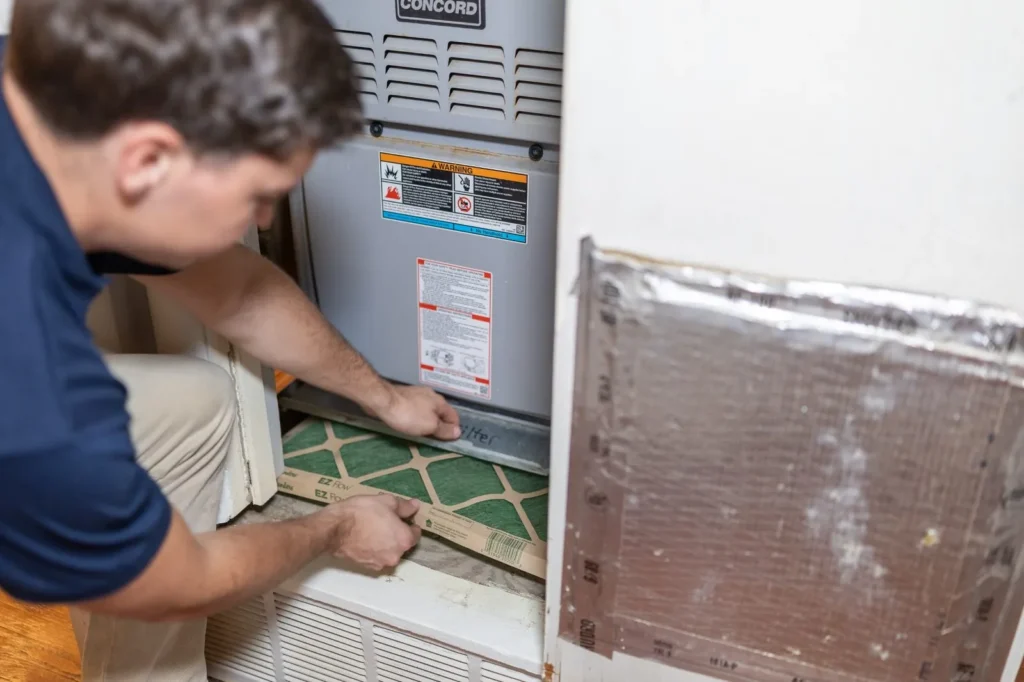
A furnace that will not start, lights and shuts off, blows cool air, or cycles every few minutes can be reacting to very different problems. Ignition, flame sensing, venting, airflow, electrical controls, the thermostat, and the blower all have to work in sequence. When one step fails, the furnace may shut itself down long before the homeowner can tell which part is responsible.
W.F. Smith repairs gas furnaces across Philadelphia and nearby Bucks and Montgomery County communities. The repair visit is built around finding the exact point of failure, explaining what it means for the rest of the system, and providing the repair price before parts are replaced.

The heating cycle begins when the thermostat asks for heat. The furnace first confirms that it can vent safely, then starts the ignition process, opens the gas valve, proves that a stable flame is present, and finally brings on the blower so heat can move into the ductwork. Modern furnaces perform those checks automatically every time they run.
That sequence is useful during diagnosis because the point where the furnace stops narrows the possibilities. A furnace that never starts its inducer has a different problem from one that lights briefly and shuts down, and both are different from a furnace that makes heat but cannot move enough air through the house.
Most newer gas furnaces use electronic ignition rather than a standing pilot. A hot-surface igniter can crack or weaken with age, while a flame sensor can become coated enough that the control board no longer receives a reliable signal that the burners are lit. In either case, the homeowner may see a furnace that tries to start but never settles into a full heating cycle.
The symptom does not prove which component failed. Venting, gas supply, pressure-switch operation, controls, or the condition of the burners can interrupt the same sequence. Testing the startup cycle matters more than replacing the part that sounds most familiar.
Older furnaces with a standing pilot keep a small flame burning so the main burners have an ignition source. When that pilot will not stay lit, the cause can involve the pilot assembly, gas flow, drafts, buildup around the burner, or the safety device that proves the flame is present.
A weak or unstable pilot is a symptom, not a complete diagnosis. Because the pilot is part of the gas and combustion system, W.F. Smith treats repeated pilot-light trouble as a furnace-repair issue rather than something the homeowner should keep relighting without knowing why it is going out.
On many older standing-pilot furnaces, the thermocouple sits in the pilot flame and helps prove that a flame is present before gas is allowed to continue flowing. If the pilot goes out, the thermocouple cools and the gas valve closes. That makes it an important safety component on the older equipment that uses one.
A pilot that will not stay lit can point toward the thermocouple, but it can also come from the pilot flame itself, the gas valve, drafts, dirt, or another condition around the burner. The useful question is not whether the thermocouple can be replaced; it is whether testing shows that the thermocouple is actually the reason the furnace cannot keep a stable pilot.
The thermostat is the beginning of the heating call, so a problem there can make the furnace appear completely dead or cause temperatures to drift away from the setting. Dead batteries, incorrect settings, wiring, location, or a failing thermostat can all affect the call for heat.
At the same time, a furnace that ignores the thermostat may have a control-board, power, safety-switch, or equipment problem instead. W.F. Smith looks at the thermostat as part of the heating system rather than assuming that replacing it will solve every cycling or temperature complaint.
Even when the burners work correctly, the furnace still has to move air through the heat exchanger and into the ductwork. A clogged filter, blocked return, blower problem, or airflow restriction can cause the furnace to run hotter than intended and trip a limit control. That often looks like short cycling from the living space: heat starts, stops, and then starts again a few minutes later.
The inducer has a different job. It establishes the draft the furnace needs before ignition. When the inducer, pressure switch, venting, or condensate path on a high-efficiency furnace is not working as expected, the control board may never allow the burners to light at all.
The heat exchanger separates combustion from the air moving through the house. A confirmed crack or other serious heat-exchanger problem is not treated like a routine igniter or thermostat repair because the safety implications and the cost can change the decision quickly.
When a heat-exchanger concern is confirmed, W.F. Smith explains the condition of the furnace and the available path forward. On older equipment, that often becomes a replacement conversation rather than another small repair, but the recommendation should follow the diagnosis and the specific furnace in front of us.
A newer furnace with one failed igniter, sensor, control, or motor may have a straightforward repair ahead of it. The decision becomes less simple when the furnace has needed repeated repairs, a major component has failed, comfort has never been right, or the system is reaching a point where another large repair does not buy much confidence for the seasons ahead.
W.F. Smith can put a repair price next to a replacement estimate when both options deserve consideration. That gives the homeowner a clearer decision than relying on age alone.
A gas smell or a carbon monoxide alarm is different from an ordinary no-heat call. Leave the home and contact the gas utility or emergency services from outside before arranging HVAC service. Repeated breaker trips, electrical burning odors, or a home losing heat during dangerous cold with a vulnerable person inside also deserve prompt attention.
Outside regular office hours, W.F. Smith’s answering service reaches the technician on call. The technician discusses the situation and the applicable after-hours rate before a visit is dispatched.
A repair solves the problem that stopped the furnace today. Fall maintenance has a different purpose: it gives the technician a chance to look at ignition, airflow, controls, and the condition of the equipment before the next long stretch of cold weather. Homeowners can book furnace maintenance as a one-time service or explore the W.F. Smith Maintenance Plan for ongoing heating and cooling maintenance through one program.
Sometimes. Age is only one part of the decision. A modest repair on an otherwise dependable furnace can still make sense, while a major repair on equipment with repeated problems may not. Comparing the repair price, overall condition, and replacement estimate gives a more useful answer.