Average SEER Rating for Central Air: The 2026 Baseline
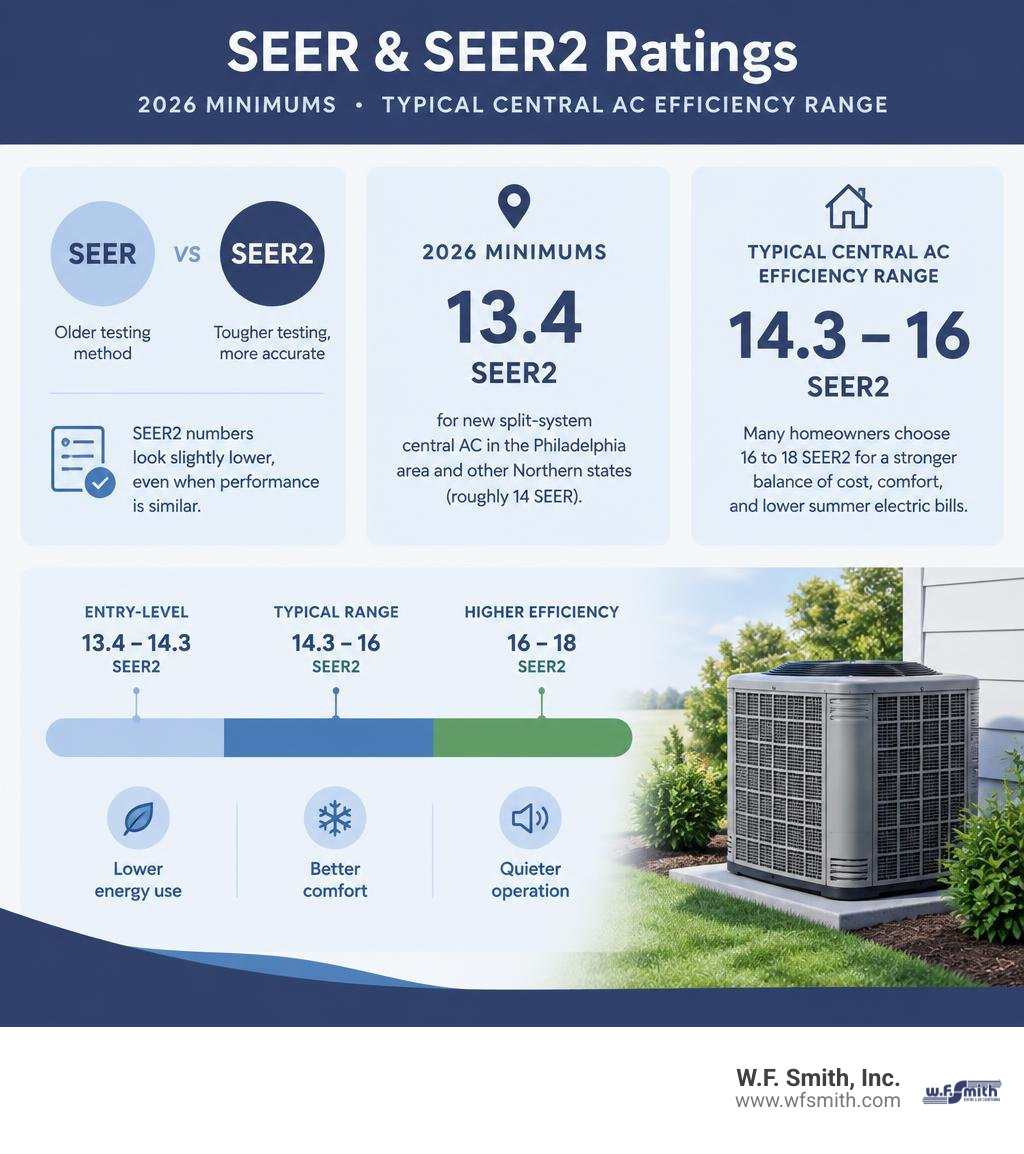
In 2026, the average SEER rating for central air is best understood as about 14.3 to 16 SEER2 for new, standard residential systems. In the Philadelphia area and other Northern states, new split-system central AC must meet at least 13.4 SEER2 (roughly 14 SEER under the older scale). Many homeowners choose 16 to 18 SEER2 for a stronger balance of upfront cost, comfort, and lower summer electric bills.
SEER2 is now the rating to compare when shopping for a new system. It uses tougher testing than the older SEER method, so its number looks slightly lower even when the equipment delivers similar real-world efficiency.
Your best choice depends on more than the label. Cooling hours, electric rates, system size, duct condition, and installation quality all affect what your AC actually costs to run. A properly sized, well-installed 16 SEER2 system can often be a smarter investment than an oversized premium model.
What Is the Average SEER Rating for Central Air in 2026?
When browsing modern air conditioners, you will notice that the efficiency floor has shifted dramatically over the past several years. Across the United States, the baseline standard for entry-level units ranges between 13.4 and 14.3 SEER2 depending on geography. Because most manufacturers build their core equipment lines slightly above the regulatory floor, the typical residential installation settles comfortably in that 14.3 to 16 SEER2 band.
Comparing SEER2 ratings across equipment tiers helps homeowners balance purchase price, comfort features, and operating costs. Units rated at 14.3 SEER2 represent budget-conscious, code-compliant cooling, while mid-tier equipment reaching 16 to 18 SEER2 can offer enhanced humidity management and quieter operation without the price of ultra-premium systems.
Understanding SEER vs. SEER2 Testing Standards
SEER stands for Seasonal Energy Efficiency Ratio. It calculates the total cooling output in British Thermal Units (BTUs) divided by the total electrical energy input in watt-hours over an entire cooling season.
Historically, legacy SEER ratings were tested under laboratory conditions that assumed minimal resistance to airflow within the system’s ductwork. To address this discrepancy, the Department of Energy mandated the M1 blower testing procedure. This updated methodology increased the external static pressure during testing by up to five times, replicating real-world residential duct resistance.
Because the test is more demanding, SEER2 ratings are roughly 4.5% to 4.7% lower than legacy SEER ratings for the exact same physical piece of equipment. For example:
- A legacy 14 SEER rating translates to roughly 13.4 SEER2.
- A legacy 15 SEER rating translates to roughly 14.3 SEER2.
- A legacy 16 SEER rating translates to roughly 15.2 SEER2.
When comparing a newly installed unit with an older model, understanding this numerical shift prevents you from thinking modern units are less efficient. They simply face a tougher test.
How Climate Zones Impact the Average SEER Rating for Central Air
Regional weather heavily influences the efficiency level that makes financial sense for your home. The Department of Energy divides the country into regional zones with distinct minimum standards:
- Northern Region (including Pennsylvania): Split-system central air conditioners must meet a minimum of 13.4 SEER2 (legacy 14 SEER). Because the cooling season is shorter, averaging 600 to 1,200 annual cooling hours, entry- to mid-tier units often deliver excellent financial returns.
- Southeast and Southwest Regions: Split-system AC units must meet a minimum of 14.3 SEER2 (legacy 15 SEER). In regions where cooling hours easily exceed 2,000 to 3,000 hours per year, a higher-efficiency unit can yield significantly greater operating savings.
Understanding local weather patterns is a key factor when deciding which SEER2 rating fits your household budget and cooling needs.
Average SEER and Efficiency Standards by Year: Then vs. Now
Efficiency standards have advanced steadily over the last three decades. Decades ago, central air conditioning systems consumed substantial electricity while providing basic, single-speed output.
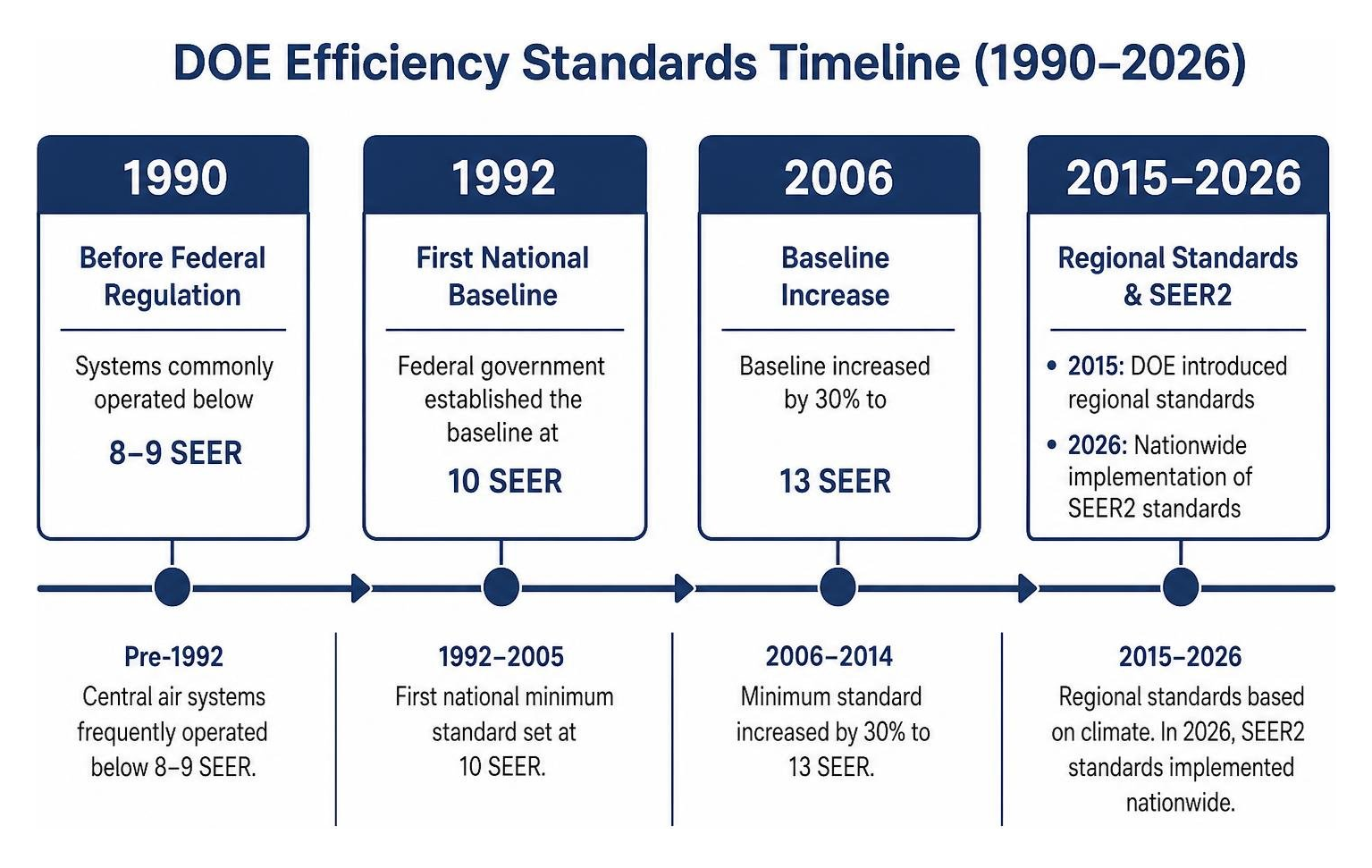
Historical Average SEER Rating for Central Air Systems (1990–2026)
Prior to federal regulation, central cooling units frequently operated at efficiency levels below 8 or 9 SEER. In 1992, the federal government established the first national baseline at 10 SEER. That standard held until 2006, when the baseline increased by 30% to 13 SEER.
In 2015, the DOE introduced regional standards to account for climate differences between the North and South. The most recent shift arrived with the nationwide implementation of SEER2 standards, which raised the bar on real-world engineering.
| Installation Era | Baseline Regulatory Standard | Typical Installed Average | Relative Energy Consumption (vs 10 SEER) |
|---|---|---|---|
| 1990–1992 | Pre-regulation (none) | 8.0 – 9.0 SEER | Baseline +20% higher power use |
| 1992–2005 | 10.0 SEER | 10.0 – 11.0 SEER | Baseline (100% reference) |
| 2006–2014 | 13.0 SEER | 13.0 – 14.0 SEER | ~23% to 30% reduction |
| 2015–2022 | 13.0 North / 14.0 South | 14.0 – 16.0 SEER | ~35% to 40% reduction |
| 2023–2026 | 13.4 SEER2 North / 14.3 SEER2 South | 15.0 – 18.0 SEER2 | ~46% to 52% reduction |
Understanding this historical progression helps illustrate how long you can expect a new AC system to last and why replacing an aging 15- to 20-year-old system can produce an immediate difference in monthly utility bills.
Federal DOE Efficiency Mandates and ENERGY STAR Benchmarks
Federal baseline mandates establish the minimum standard allowed by law, but voluntary programs like ENERGY STAR highlight high-performing systems:
- ENERGY STAR Standard Tier: Requires central split-system air conditioners to achieve at least 15.2 SEER2 (and 12.0 EER2).
- ENERGY STAR Most Efficient: Recognizes advanced equipment reaching 17.5 SEER2 or higher.
Higher-efficiency equipment can reduce household energy use and help limit peak-season demand on the electrical grid.
Cost vs. Energy Savings: Is a Higher SEER Rating Worth the Upfront Price?
When looking at replacement options, equipment costs scale with efficiency. Balancing capital outlay against operating expense is a central part of understanding how to budget for new HVAC upgrades.
The Efficiency Sweet Spot (16–18 SEER2 vs. 20+ SEER2)
While high ratings are technically impressive, efficiency returns follow an economic curve of diminishing returns.
- Entry-Level (13.4–14.3 SEER2): Lowest initial cost, single-stage operation, fully code-compliant.
- The Sweet Spot (16–18 SEER2): Modest price premium ($800–$2,500 over base), multi-stage or variable-speed operation, superior dehumidification, and noticeable energy bill reductions.
- Ultra-High Tier (20–24+ SEER2): Substantial upfront investment ($4,000–$8,000+ premium), advanced modulating inverters, and ultra-quiet sound ratings.
For most homeowners in moderate cooling zones, units rated between 16 and 18 SEER2 deliver the best 10-to-15-year total cost of ownership. Over a decade, the marginal energy savings of jumping from 18 SEER2 to 24 SEER2 often fail to recoup the higher initial equipment cost before the system reaches the end of its service life.
Financing can make a mid-tier upgrade more manageable without stretching a household budget. This overview of how to finance a new HVAC system explains options homeowners can consider.
Calculating Real-World Energy Bill Reductions and Payback
Upgrading an obsolete system yields substantial energy reductions:
- Replacing an old 10 SEER system from the early 2000s with an 18 SEER2 unit reduces cooling power consumption by roughly 46% to 52%.
- A standard 14 SEER baseline unit in a moderate climate can cost around $700 annually in cooling electricity, while an 18 SEER2 system can lower that cost to roughly $330 to $350, saving more than $3,500 over 10 years.
If your current system is failing, the best time to get a new air conditioner may be the off-season, when contractor availability and utility rebates can be easier to evaluate.
Key Factors That Affect Real-World SEER Performance
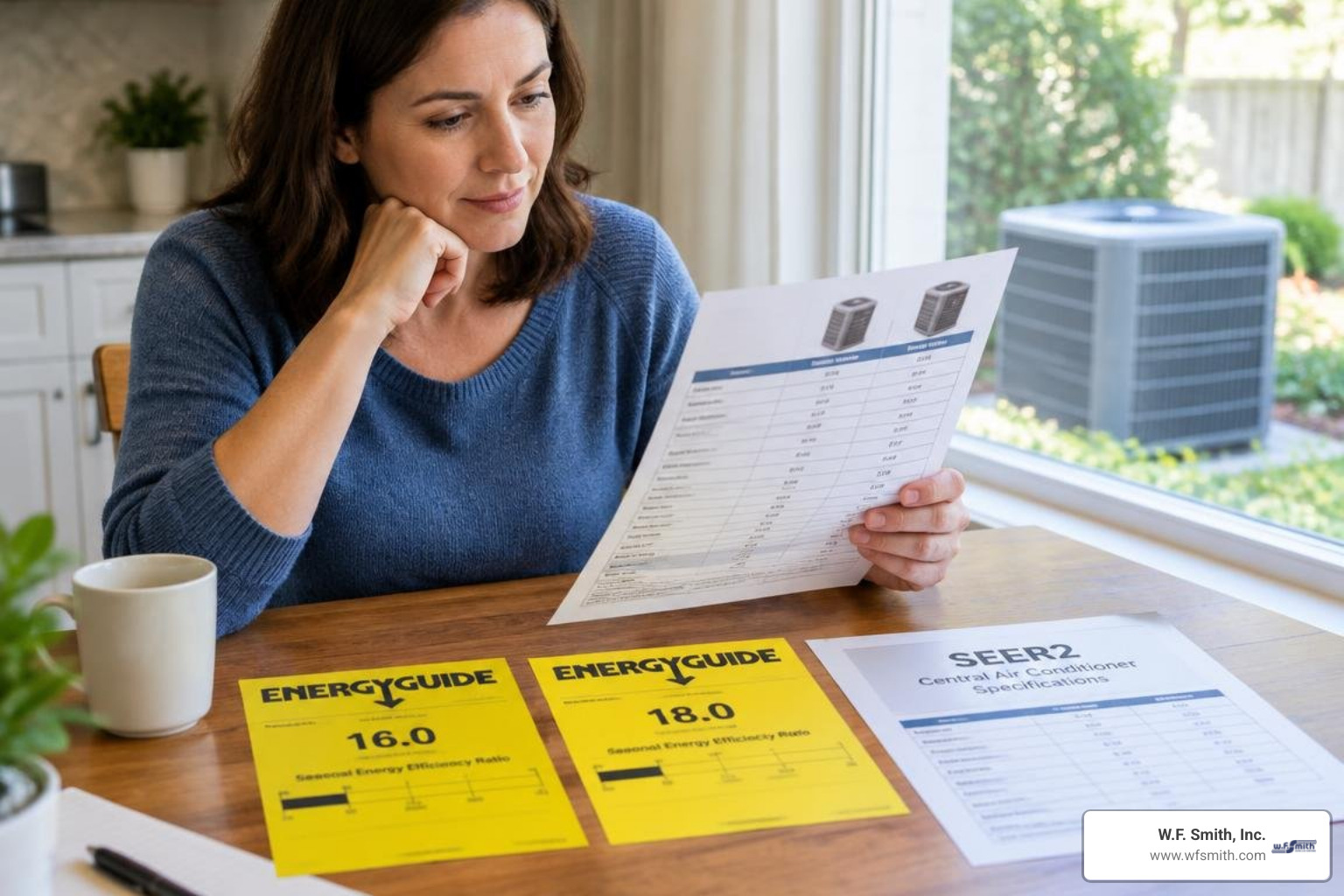
An air conditioner’s yellow EnergyGuide label reflects potential efficiency under laboratory conditions. Reaching that performance in your home requires avoiding common installation pitfalls.
The common HVAC installation mistakes to avoid show why quality craftsmanship matters just as much as equipment specifications.
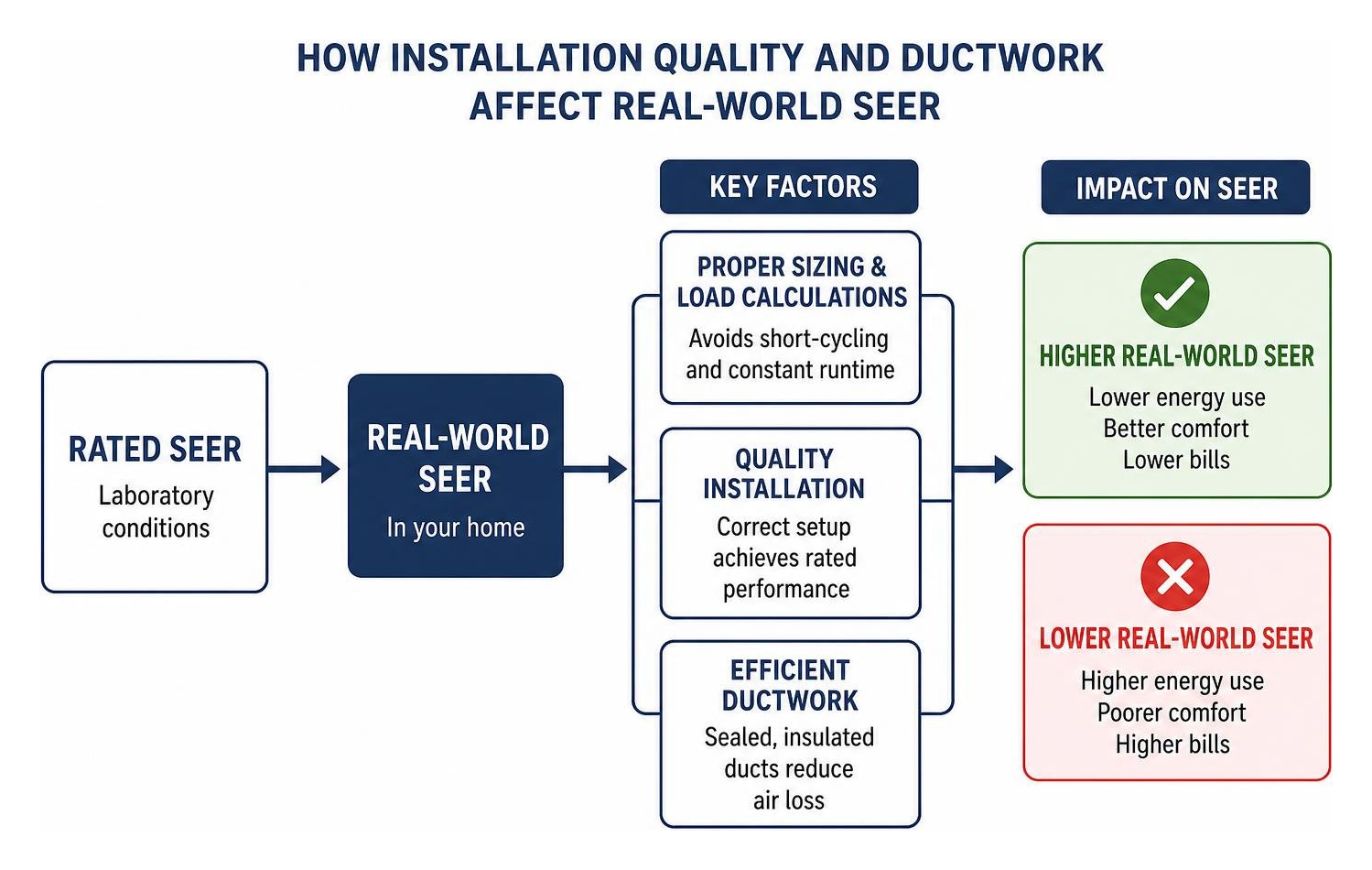
Proper Sizing, Load Calculations, and Ductwork
An oversized air conditioner short-cycles, turning on and off rapidly without running long enough to remove humidity from indoor air. Conversely, an undersized system runs constantly without reaching the thermostat setpoint on hot afternoons.
To achieve rated efficiency:
- Load Calculations: Installers should perform ACCA Manual J calculations. The importance of installing HVAC with load calculations is clear when a home’s square footage, window placement, insulation, and orientation are all considered.
- Tonnage Sizing: Correct capacity prevents excess wear and supports consistent comfort throughout the cooling season.
- Duct Integrity: Leaky or uninsulated ductwork can lose 20% to 30% of conditioned air into unconditioned attics or crawlspaces, reducing an 18 SEER2 system to the field performance of a 12 SEER unit. A duct evaluation can help verify airflow and duct readiness before new equipment arrives.
Single-Stage vs. Two-Stage and Variable-Speed Compressors
Compressor design determines how closely a system matches your cooling demand:
- Single-Stage Compressors: Operate at 100% capacity whenever turned on. Simple and durable, but they cycle frequently and create slight temperature swings.
- Two-Stage Compressors: Run at roughly 65–70% capacity during mild weather and switch to 100% capacity on hot afternoons, improving efficiency and indoor comfort.
- Variable-Speed (Inverter) Compressors: Modulate seamlessly between 25% and 100% capacity in small increments. They run for extended, low-speed cycles, maintaining steady temperatures, quiet operation, and effective humidity removal.
Professional AC installation helps ensure that multi-stage and variable-speed systems are configured correctly with compatible thermostats and balanced ductwork.
Frequently Asked Questions About Central AC Efficiency
What AC rebates or incentives may be available in 2026?
For a central AC or heat-pump upgrade in 2026, compare options based on efficiency, comfort, reliability, expected utility-bill savings, and total installed cost. SEER2 and ENERGY STAR ratings can help you evaluate equipment performance, while any available incentives should be confirmed directly with the local utility, state program, manufacturer, or installing contractor before you factor them into your budget.
SEER2 and ENERGY STAR ratings can help you compare central AC equipment for efficiency, comfort features, and potential energy use. Before relying on a rebate or promotion, confirm the program’s current requirements, service area, qualifying equipment, and application process directly with the local utility, state program, manufacturer, or installing contractor.
How do I find my current central air conditioner’s SEER rating?
You can find your unit’s efficiency rating through several simple methods:
- The EnergyGuide Label: Look for the bright yellow sticker on the side of the outdoor condenser cabinet.
- The Manufacturer Nameplate: Locate the metal data plate on the outdoor unit to find the model number. The nominal SEER rating is often embedded in the model code (for example, a model number containing “16AC” frequently denotes a 16 SEER design).
- AHRI Directory: Search the indoor coil and outdoor unit model numbers on the Air-Conditioning, Heating, and Refrigeration Institute (AHRI) directory to retrieve the certified match rating.
Can I connect a high-SEER outdoor condenser to an older indoor coil?
Connecting a modern, high-SEER2 outdoor unit to an old, mismatched indoor evaporator coil is not recommended. Mismatched components prevent the expansion valve and refrigerant lines from metering correctly, often reducing effective efficiency by 15% or more and voiding the manufacturer’s warranty.
When planning an AC replacement, replacing both the outdoor condenser and indoor coil (or air handler) ensures AHRI-certified matched performance, full efficiency gains, and long-term equipment reliability.
Conclusion: Choosing the Right SEER Rating for Your Home
Selecting the right central air conditioner involves balancing initial purchase price, regional climate demands, and long-term operating costs. While the national average sits between 14.3 and 16 SEER2, stepping up to a 16 to 18 SEER2 two-stage or variable-speed unit often provides the ideal combination of steady indoor comfort, low humidity, and manageable utility bills.
For more than 80 years, the W.F. Smith, Inc. team has provided heating, cooling, and indoor air quality services throughout the greater Philadelphia area. The team offers transparent guidance, 24/7 emergency support, and a 100% satisfaction guarantee on every installation.
For a system recommendation and installation quote, contact our AC installation specialists.