- 24/7 Emergency HVAC Repair
- Financing Available
- We Accept All Major Credit Cards
AC Compressor Replacement Cost: When Is Replacement Worth It?
Air Conditioner Compressor Replacement Cost for Home in 2026
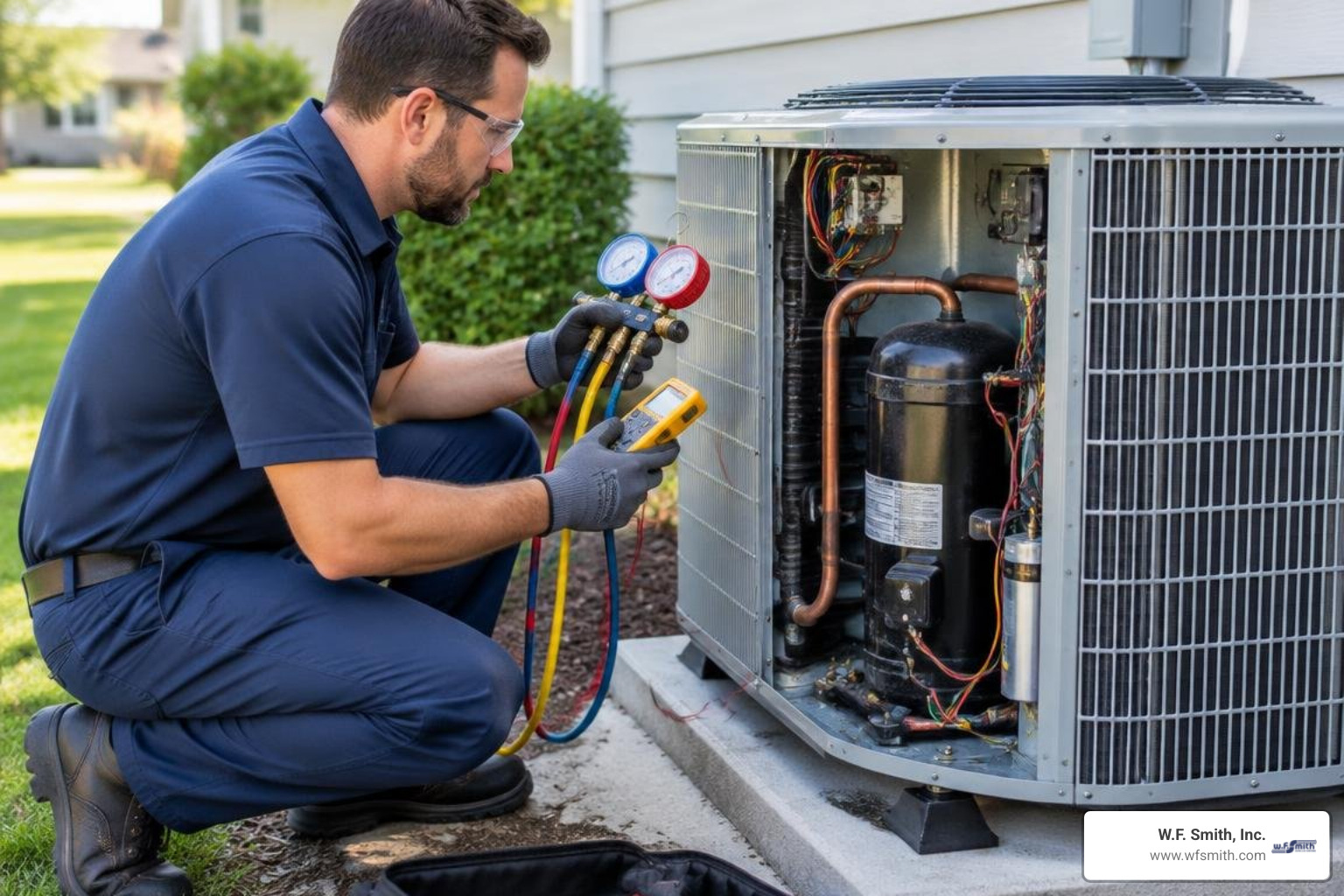
When an air conditioner fails in the middle of a hot summer, a failed compressor is often the most expensive single part to fix. In 2026, typical replacement projects range from $1,100 on smaller, standard systems to $4,650 or more for large, high-efficiency units when the compressor is out of warranty. National cost estimates commonly place a standard residential compressor replacement near $2,000, although the final price depends on system size, refrigerant, labor, and warranty coverage.
A compressor functions as the heart of your cooling equipment, pumping refrigerant through copper line sets between your outdoor condenser and your indoor evaporator coil. Because replacing it requires cutting refrigerant lines, extracting spent gas, brazing in the new pump, pulling a deep vacuum, and recharging the system, the total bill reflects both equipment costs and intensive mechanical labor.
Before moving forward with an expensive swap, professional air conditioner repair services should confirm that the compressor motor has truly suffered a mechanical seizure or an electrical burnout rather than a simple failure of an exterior electrical component.
Estimating Air Conditioner Compressor Replacement Cost for Home by System Tonnage
Cooling capacity is measured in tons, with one ton equating to 12,000 BTUs per hour. Larger homes require larger capacity equipment, which in turn demands larger compressor motors with higher displacement capacities.
Here is a look at standard pricing expectations across residential sizes for both out-of-warranty and under-warranty equipment:
| System Capacity (Tonnage) | Typical Home Size (Sq. Ft.) | Out-of-Warranty Replacement Range | Under-Warranty Cost (Labor & Refrigerant Only) |
|---|---|---|---|
| 1.5 Tons | 600 – 1,000 sq. ft. | $1,100 – $1,800 | $600 – $1,100 |
| 2.0 Tons | 1,001 – 1,400 sq. ft. | $1,300 – $2,300 | $700 – $1,350 |
| 2.5 Tons | 1,401 – 1,750 sq. ft. | $1,450 – $2,800 | $750 – $1,600 |
| 3.0 Tons | 1,751 – 2,200 sq. ft. | $1,500 – $3,400 | $800 – $1,950 |
| 3.5 Tons | 2,201 – 2,600 sq. ft. | $1,700 – $3,800 | $900 – $2,200 |
| 4.0 Tons | 2,601 – 3,200 sq. ft. | $2,000 – $4,200 | $1,050 – $2,400 |
| 5.0 Tons | 3,201 – 4,000+ sq. ft. | $2,400 – $4,650+ | $1,200 – $2,650+ |
Square footage ranges are generalized; home insulation levels, window placement, ceiling height, and local climate also shape the exact tonnage required. Sizing must always be verified to match your existing outdoor coil and indoor metering device.
Cost Variations by Compressor Stage and Efficiency Type
Beyond physical size, the mechanical design of the compressor plays a major role in pricing:
- Single-Stage Compressors ($500 – $1,500 for the part alone): These units operate on a simple on/off binary. When the thermostat calls for cooling, the compressor runs at 100% capacity until the setpoint is reached. While less expensive upfront, they provide the lowest operational efficiency.
- Two-Stage Compressors ($1,000 – $2,500 for the part alone): These models feature a high and low setting, typically operating at roughly 65–70% capacity on milder days and 100% on peak heat days. They offer better humidity control and lower electrical demand, but the internal valving and specialized electronics raise the part cost.
- Variable-Speed / Inverter Compressors ($1,800 – $3,200 for the part alone): Modulating compressors adjust speed incrementally across dozens of stages to match cooling demand within fractions of a degree. While delivering superior SEER2 efficiency and quiet operation, their proprietary electronic inverters and complex internal components make replacement significantly more expensive.
Key Factors That Influence Total Compressor Replacement Pricing
Every HVAC installation carries unique layout challenges. Compressor technology, brand compatibility, unit accessibility, permitting, and line-set length can all move a final estimate higher or lower.
If your home feels sticky even when the AC is running, the underlying issue may involve system sizing, airflow, or equipment performance rather than the compressor alone. The team explains these comfort issues in Why Is Your Home Humid With the AC Running?.
- Compressor Technology & Tonnage: As detailed above, an inverter-driven 5-ton scroll compressor costs substantially more than a 2-ton single-stage reciprocating model.
- Brand Compatibility: Premium brand compressors or proprietary modulating scrolls carry higher wholesale parts pricing than generic aftermarket replacements.
- Physical Accessibility: Units installed on steep rooftops, tight crawlspaces, or elevated brackets require extra setup time and safety precautions, increasing total billable hours.
- Local Municipal Permitting: Many local building departments require permits and post-installation mechanical inspections for major HVAC refrigeration repairs, which can add $75 to $250 to project totals.
- Line Set Length and Elevation: Longer copper runs require more refrigerant to charge the system to factory-specified subcooling levels.
Labor and Refrigerant: Factors in Air Conditioner Compressor Replacement Cost for Home
Labor and refrigerant together make up between 50% and 70% of the entire invoice for an out-of-warranty compressor swap.
Replacing a compressor is not a basic bolt-on repair. The process requires 4 to 6 hours of skilled work by licensed HVAC technicians, with typical industry labor rates of $75 to $150 per hour.
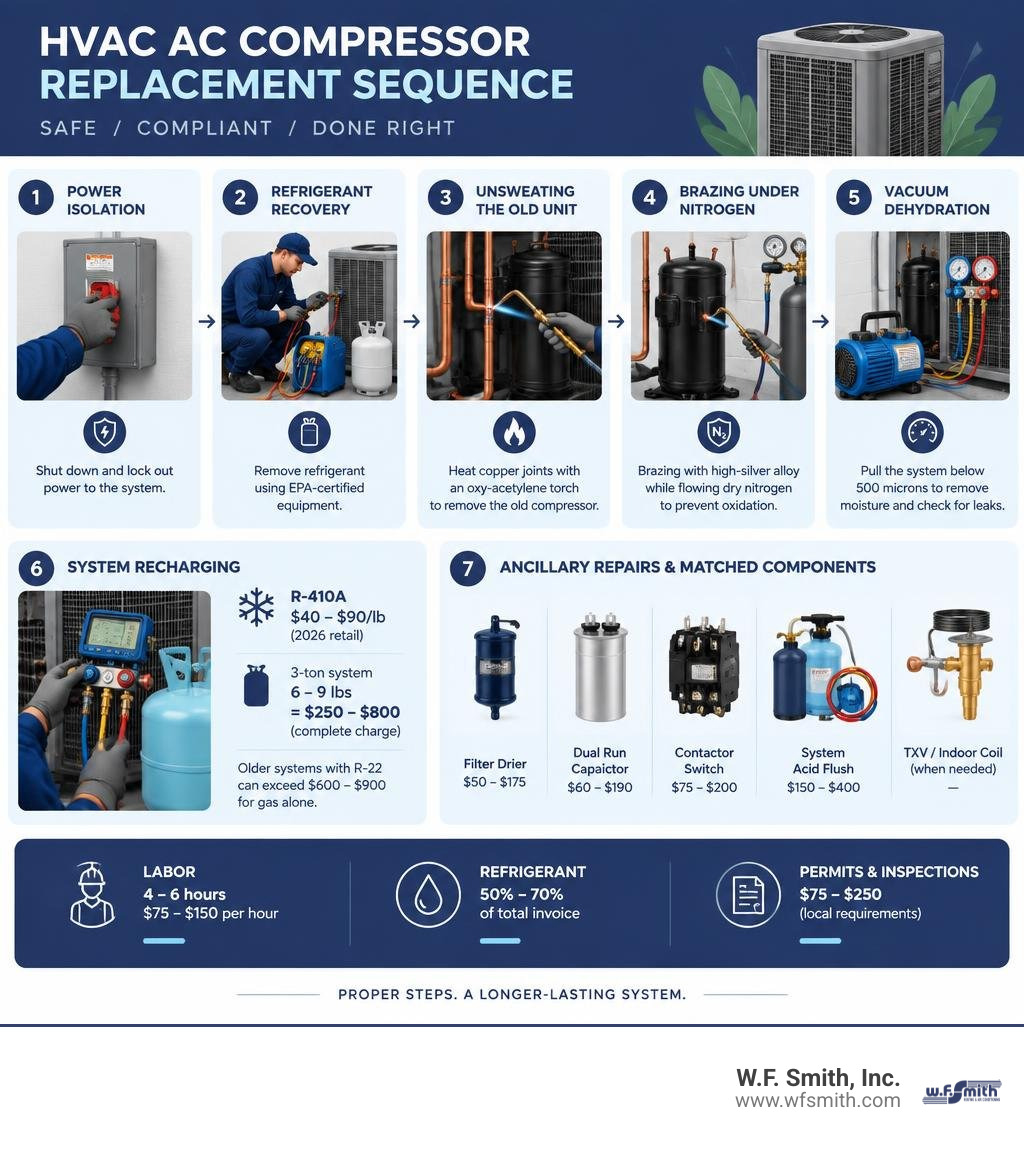
The technician must complete several mandatory steps:
- Refrigerant Recovery: By law, technicians must hook up an EPA-certified recovery machine and tanks to evacuate the remaining refrigerant without venting it into the atmosphere.
- Unsweating the Old Unit: Using an oxy-acetylene torch, the technician heats the copper suction and liquid joints to remove the damaged compressor.
- Brazing Under Nitrogen: The replacement unit is set in place and brazed with high-silver-content alloy while flowing dry nitrogen through the lines to prevent copper oxidation scale from forming inside the piping.
- Vacuum Dehydration: The technician connects a multi-stage vacuum pump to pull the entire system down below 500 microns to boil away internal moisture and verify system tightness.
- System Recharging: A qualified HVAC team performs precise AC refrigerant recharging using digital scales to weigh in the exact factory specification. In 2026, R-410A runs $40 to $90 per pound at standard retail service rates. Because a 3-ton system holds 6 to 9 pounds, a complete charge can add $250 to $800 to the bill. Older systems using phased-out R-22 can exceed $600 to $900 just for the gas.
Ancillary Repairs and Matched Components
When a compressor fails, it rarely happens in complete isolation. Technicians routinely replace critical support components to protect the new compressor from premature failure:
- Liquid-Line Filter Drier ($50 – $175): Replacing this component is mandatory on every sealed-system repair to trap residual moisture, acid, and particulates. Skipping it voids nearly all manufacturer warranties.
- Dual Run Capacitor ($60 – $190): A degraded capacitor provides weak electrical phase shift to the motor windings, causing hard starts and excessive heat buildup.
- Contactor Switch ($75 – $200): Pitted, burned high-voltage electrical contacts can weld shut or create voltage dropouts that destroy a new motor.
- System Acid Flush ($150 – $400): If the previous compressor suffered an electrical burnout, acidic oil is distributed throughout the line set. The system must be flushed, or burn-out cleanup filter driers must be installed on both liquid and suction lines.
- Thermostatic Expansion Valve (TXV) or Indoor Coil Issues: A restricted metering device starves the compressor of cool return gas, leading to repeated overheating. In some cases, concurrent AC coil repair is required to address leaks or restrictions at the evaporator.
Replacing the Compressor vs. Installing a New AC System

When faced with a repair quote of $2,000 to $3,500, every homeowner confronts the same dilemma: should you repair the existing unit or invest that capital into a complete system upgrade?
A widely used industry framework is the $5,000 Rule: multiply the age of your air conditioning system in years by the total repair quote. If the resulting number exceeds $5,000, whole-system replacement is often the more sensible financial decision.
- Example A: An 8-year-old system needing a $2,200 compressor repair scores $17,600 (8 × $2,200). Because it far exceeds $5,000 and is nearing the end of its 10–15 year design life, replacing the system is often the smarter route.
- Example B: A 3-year-old system under parts warranty needing an $800 labor repair scores $2,400 (3 × $800). Here, completing the repair makes sense.
Replacing the entire outdoor condenser with a matched indoor coil typically costs $3,200 to $6,500, while a complete central AC system replacement can run between $4,500 and $9,000 in 2026. If an out-of-warranty compressor swap costs $3,000 on a 12-year-old condenser, you are paying close to the price of a new outdoor condenser without receiving new warranty protection for aging fan motors, coils, or indoor electronics.
Before committing to a replacement, consider the installation details that affect comfort, airflow, and long-term system performance. What Homeowners Overlook Before Replacing Their AC System outlines practical questions to discuss with your HVAC contractor.
When an older unit begins failing repeatedly, selecting a full air conditioner replacement gives you new warranty coverage, higher energy efficiency ratings, and more predictable long-term performance.
System Age Thresholds and Long-Term Efficiency
Air conditioner compressors are designed to last between 10 and 15 years under proper annual maintenance.
If your equipment is over 10 years old:
- Efficiency Drops: Older units operating at 10 to 13 SEER consume significantly more kilowatt-hours each summer than modern 15.2 to 18+ SEER2 systems. Upgrading can reduce seasonal cooling bills by 20% to 40%.
- Cascading Failures: An older unit with a brand-new compressor still relies on a decade-old condenser fan motor, corroded aluminum fins, and an aging indoor evaporator coil that may develop refrigerant leaks shortly after the repair.
- Incentives: Modern high-efficiency systems may qualify for federal energy-efficiency tax credits and local utility rebates, helping offset the net installation investment.
Evaluating Warranty Status and Hidden Out-of-Pocket Costs
Most major equipment manufacturers provide a standard 5-year base parts warranty, which expands to a 10-year limited parts warranty if the original homeowner registered the equipment within 60 to 90 days of installation.
However, manufacturer warranties cover only the replacement part itself. The homeowner remains responsible for:
- Diagnostic dispatch fees
- HVAC technician labor hours ($400 – $1,200)
- Refrigerant recovery and new refrigerant charge ($250 – $800)
- Filter driers, flush chemicals, and miscellaneous shop supplies ($100 – $300)
- Warranty processing and freight charges from the distributor ($75 – $150)
This is why an “under warranty” compressor replacement can still generate an out-of-pocket invoice of $600 to $2,650.
Signs of a Failing Compressor and Diagnostic Checklist
Compressors rarely fail without warning. Catching these operational symptoms early can prevent catastrophic motor burnout:
- Warm Air From Supply Registers: If your indoor blower is pushing air but the temperature does not drop, the compressor may have failed to engage, leaving refrigerant stagnant.
- Hard Starting and Rattling Noises: A metallic clattering, squealing, or severe vibration upon startup can indicate worn internal mechanical bearings, damaged scroll spirals, or failing internal valves.
- Frequently Tripped Circuit Breakers: If the outdoor AC breaker trips every time the cooling cycle starts, the compressor motor windings may have shorted to ground or the pump may have locked up mechanically, drawing excessive locked-rotor amps (LRA).
- Hissing or Bubbling Sounds: Persistent bubbling can point to an active refrigerant leak. When refrigerant runs low, the compressor loses lubrication and cooling, causing it to overheat and burn out.
- Dimming House Lights on Start: If interior lights dim noticeably when the AC kicks on, the compressor may be struggling against high head pressure or have failing start components.
If your unit shows these warning signs during high summer heat, emergency air conditioning repair in Philadelphia can help isolate the root cause before total compressor seizure occurs.
A qualified HVAC team should provide an honest assessment of whether the compressor can be saved with an electrical repair or whether replacement is the better path forward.
Frequently Asked Questions About Home AC Compressor Replacement
Can I replace an AC compressor myself?
No. Replacing a residential AC compressor is not a DIY-friendly project. Under Section 608 of the Clean Air Act, it is a violation of federal law for uncertified individuals to purchase, handle, or release regulated refrigerants.
Beyond legal restrictions, the repair demands thousands of dollars in specialized trade tools, including:
- Refrigerant recovery stations and DOT recovery cylinders
- Oxy-acetylene or high-heat MAP brazing torches
- Two-stage deep vacuum pumps and digital micron gauges
- Digital refrigerant charging scales and manifold sets
- Dry nitrogen pressure-testing tanks and high-pressure regulators
Improper brazing introduces carbon soot into the lines, destroying the new compressor within hours. Handling high-voltage electricity and pressurized refrigerants also presents severe shock, burn, and frostbite hazards.
How long does a home AC compressor typically last?
A well-maintained home AC compressor lasts 10 to 15 years. In milder climates with shorter cooling seasons, units frequently last 15 to 18 years, whereas in extreme Southern climates where systems run constantly, lifespan can drop closer to 8 to 12 years.
You can extend the lifespan of your compressor by changing air filters regularly, keeping outdoor condenser coils clear of leaves and debris, scheduling annual tune-ups, and addressing small refrigerant leaks immediately before low suction pressures cause motor overheating.
How does the EPA R-410A phasedown impact replacement costs?
Under the American Innovation and Manufacturing (AIM) Act, the EPA began phasing down the production and importation of hydrofluorocarbon (HFC) refrigerants like R-410A to transition toward lower-global-warming-potential alternatives such as R-454B and R-32.
This phasedown affects compressor replacement in two key ways:
- Rising Refrigerant Costs: As virgin R-410A production allowances decrease annually, the market price per pound of R-410A can rise, increasing the refrigerant line item on repair bills.
- Legacy Repairs Are Allowed: You are not legally required to replace an operational R-410A system, and replacement compressors for existing R-410A units remain available through supply houses. However, as these systems age, major sealed-system repairs can become more expensive compared with installing modern next-generation equipment.
Conclusion
A compressor replacement is one of the most substantial investments you can make in an existing cooling system. With an out-of-warranty air conditioner compressor replacement cost for home ranging from $1,500 to $3,000 for standard systems, and reaching upwards of $4,650 on high-efficiency, multi-stage platforms, making the right choice requires a clear evaluation of system age, warranty standing, and long-term operating costs.
Always insist on a thorough diagnostic evaluation before authorizing a compressor replacement to ensure a bad capacitor or contactor switch is not misdiagnosed as a seized motor. If your system is over 10 to 12 years old, compare the repair quote against a modern high-efficiency replacement that comes with full warranty protection.
W.F. Smith, Inc.’s experienced HVAC team has provided heating, cooling, and indoor-air-quality solutions throughout the Philadelphia region for more than 80 years. For a clear diagnosis and replacement options, contact our professional AC compressor repair technicians.

W.F. Smith was great. They worked very professionally and neatly. They were extremely knowledgeable about the equipment and all specific HVAC practices. Would recommend them to the world!