- 24/7 Emergency HVAC Repair
- Financing Available
- We Accept All Major Credit Cards
AC and Furnace Replacement: Should You Replace Both at the Same Time?
What Is an AC and Furnace Combo and How Does It Work?

At its core, a central heating and cooling combo brings two dedicated systems together through a single duct network. Rather than operating as disconnected mechanical setups, the AC and gas furnace share critical air-handling infrastructure.
During the summer, the outdoor condensing unit pumps refrigerant to the evaporator coil. Warm indoor air is pulled across the coil, transferring heat outside and leaving cooled, dehumidified air behind. In the winter, combustion inside the furnace warms the heat exchanger. The indoor blower motor pushes household air across the outside of that heat exchanger, sending warm air through the supply registers.
Because both heating and cooling cycles use the same central ductwork, filter rack, and electrical controls, matching these components helps maintain balanced airflow throughout the year.
How the Gas Furnace and Air Conditioning Coils Interact
In a standard split setup, the indoor cased evaporator A-coil sits directly on top of, or alongside, the gas furnace cabinet.
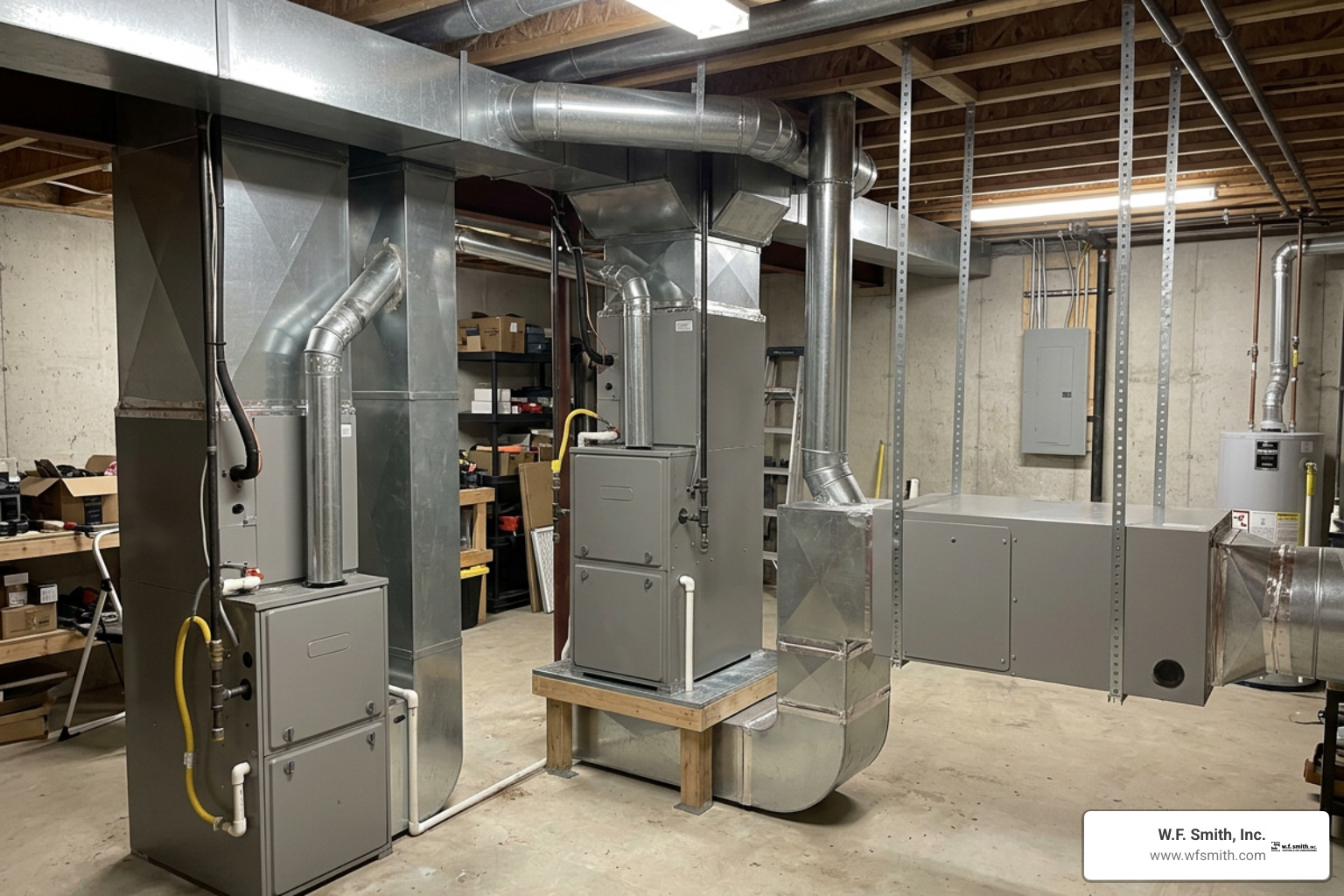
Inside the furnace cabinet are the burner assembly, gas valve, primary and secondary heat exchangers, and an electronically commutated motor (ECM) blower. When cooling is called, the outdoor AC unit engages its compressor, but it relies on the indoor furnace blower to move conditioned air through the home.
Modern furnaces help high-efficiency air conditioners receive the precise cubic feet per minute (CFM) of airflow needed to reach their tested efficiency levels. Pairing a new high-efficiency cooling coil with an older single-speed furnace blower can restrict airflow, freeze the coil, and reduce expected energy savings.
Split System vs. Packaged AC and Furnace Combo Options
Homeowners typically choose between two physical architectures: a traditional split system or a self-contained packaged unit.
In the United States, most new residential construction uses split systems, while packaged units serve a smaller share of homes. A split system keeps the condenser outdoors while the furnace, air filtration, and evaporator coil remain protected in a basement, utility closet, or attic.
A packaged HVAC system places the compressor, condenser fan, evaporator coil, burner assembly, and blower inside one heavy-duty outdoor cabinet. Packaged units can be a practical option for slab-on-grade homes without a basement or crawlspace, manufactured homes, and homes with flat roofs.
| Feature | Split System Combo | Packaged HVAC Unit Combo |
|---|---|---|
| Component Placement | Outdoor condenser + indoor furnace and coil | All components housed in one outdoor cabinet |
| Indoor Space Required | Requires basement, closet, or attic space | No indoor utility footprint required |
| Weather Exposure | Furnace and coils protected indoors | Components exposed to outdoor elements |
| Installation Complexity | Requires indoor and outdoor refrigerant line sets | Outdoor connection directly to duct stubs |
| Service Access | Split between indoor and outdoor locations | Most service access from one exterior panel |
| Ideal Architectural Fit | Multi-story homes and homes with basements | Flat-roof properties and slab-on-grade foundations |
System Types: Standard Cooling vs. Dual-Fuel Hybrid Systems
When planning a replacement, the primary mechanical decision is whether you want a standard straight-cool AC paired with a furnace or an advanced dual-fuel hybrid system.
Traditional Straight-Cool AC and Gas Furnace
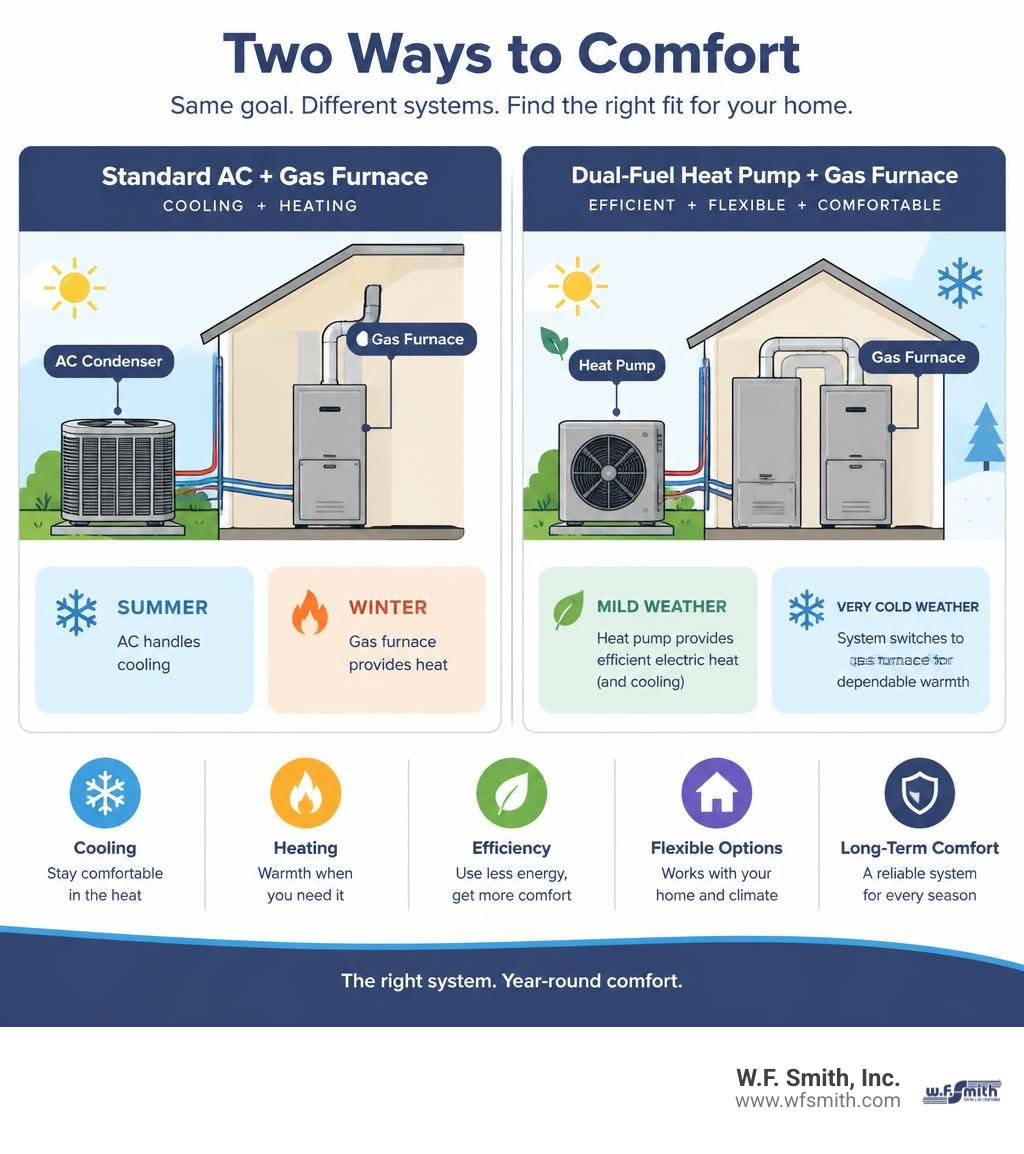
A traditional pairing combines a dedicated electric AC condenser outdoors with a natural gas or propane furnace indoors. The AC handles summer cooling, while the gas furnace provides fast, high-temperature heat when winter temperatures fall.
For homeowners prioritizing a straightforward design and lower upfront equipment costs, a professional air conditioner replacement can restore dependable summer comfort while improving efficiency and humidity control.
When the existing heating equipment is also aging or no longer matches the new cooling system, a coordinated furnace replacement helps the full HVAC system deliver the airflow and performance it was designed to provide.
Dual-Fuel Inverter Heat Pump and Gas Furnace Systems
A dual-fuel setup replaces the standard cooling-only condenser with an electric heat pump. Modern heat pumps use variable-speed inverter compressors to run in reverse during spring and fall, extracting heat from outdoor air to warm the home efficiently.
A dual-fuel heating system combines a heat pump with a gas furnace. During mild weather, the heat pump can provide efficient electric heat. When temperatures become very cold, the system can switch to the gas furnace for dependable high-output warmth.
The right capacity, efficiency level, and changeover temperature depend on your home’s load calculation, ductwork, fuel costs, and local winter conditions. A qualified HVAC contractor can recommend equipment that is properly matched instead of relying on a one-size-fits-all configuration.
Sizing, Efficiency Ratings, and Airflow Configurations
Selecting new heating and cooling equipment requires evaluating technical capacity, efficiency standards, and physical layout requirements.
Calculating BTU and Cooling Tonnage
AC capacity is measured in nominal tons, with one ton equaling 12,000 BTUs of heat removal per hour. Residential systems generally range from 1.5 to 5 tons. Furnace heat output is measured in British thermal units (BTUs), with typical residential inputs ranging from 40,000 to 120,000 BTUs.
Avoid relying on square-footage rules of thumb alone. A qualified contractor should perform a Manual J load calculation that considers:
- Window orientation and solar heat gain
- Wall, ceiling, and foundation insulation values
- Air infiltration and structural leakage rates
- Regional climate extremes
Understanding what BTU and AFUE your new furnace should have can help you see how heating capacity and efficiency affect comfort without contributing to short cycling or elevated indoor humidity.
Understanding SEER2, AFUE, and Low-GWP Refrigerants
Efficiency metrics determine long-term operating costs:
- SEER2 (Seasonal Energy Efficiency Ratio 2): Measures cooling efficiency under realistic duct static-pressure conditions. Modern systems range from 13.4 SEER2 to more than 20 SEER2.
- AFUE (Annual Fuel Utilization Efficiency): Measures furnace combustion efficiency. An 80% AFUE furnace converts about 80 cents of every fuel dollar into usable indoor heat, while high-efficiency condensing furnaces can achieve 95% to 98% AFUE.
Our guide to understanding SEER ratings explains how cooling-efficiency ratings can influence equipment selection and operating costs.
Modern AC systems and heat pumps may use lower-global-warming-potential refrigerants such as R-454B or R-32. Equipment compatibility and refrigerant selection should always be confirmed by a licensed HVAC professional.
Airflow Orientations: Upflow, Downflow, and Horizontal
Physical layout determines how air circulates across the furnace heat exchanger and evaporator coil:
- Upflow: Cold return air enters at the bottom of the furnace and exits at the top into supply trunk lines. This is common in basement and utility-room installations.
- Downflow (Counterflow): Return air enters through the top of the cabinet, passes across the burners and coils, and discharges downward into subfloor duct systems. This is common in slab-on-grade homes and manufactured-home applications.
- Horizontal (Left or Right): The furnace and cased coil rest horizontally, pulling return air from one end and discharging conditioned air from the other. This configuration is often used in crawlspaces and residential attics.
Many modern evaporator coils and furnaces are multi-positional, allowing technicians to configure them for upflow, downflow, or horizontal installations that match the existing duct connections.
Total Replacement Costs, Longevity, and Performance
Replacing the AC and furnace together represents a notable upfront investment, but it can provide labor efficiencies and long-term utility savings.
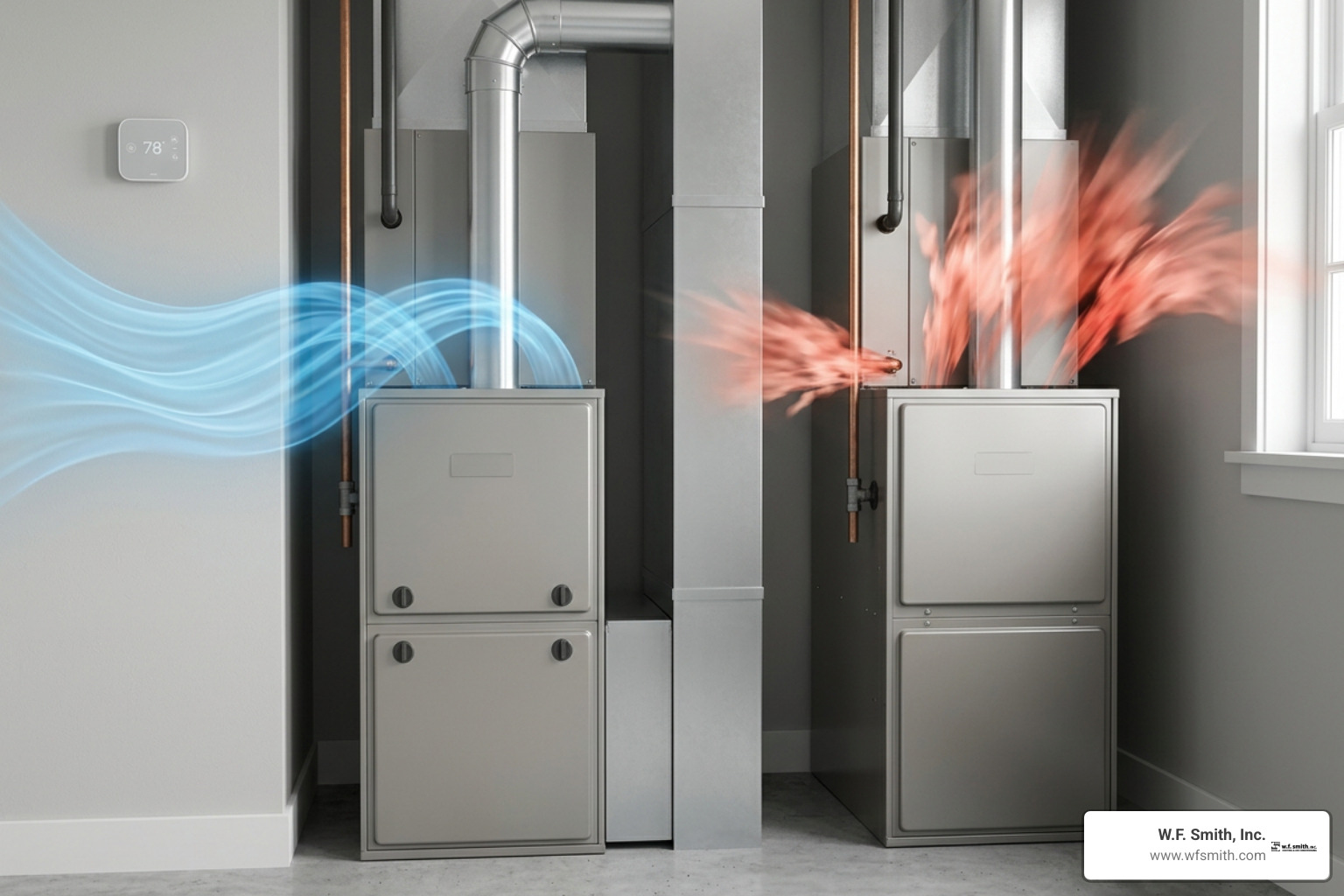
Factors That Determine AC and Furnace Combo Cost
A complete AC and gas furnace combo replacement often ranges from $8,000 to $17,000+, depending on equipment capacity, efficiency tier, and installation complexity.
Several variables influence the final investment:
- Efficiency tier: Upgrading from standard 80% AFUE and 14.3 SEER2 equipment to premium 96% AFUE and 18+ SEER2 variable-speed systems increases initial equipment costs while potentially improving long-term energy savings.
- Electrical and venting modifications: High-efficiency condensing furnaces require dedicated PVC, CPVC, or polypropylene venting rather than standard metal chimneys. A new outdoor AC unit may also require an updated disconnect, surge protection, or electrical work.
- Ductwork modifications and transitions: Custom sheet-metal transitions may be needed to connect new indoor coils and furnace cabinets to existing supply and return plenums.
- Professional labor and permitting: Experienced HVAC services in Philadelphia, PA help ensure code compliance, accurate refrigerant charging, and warranty-ready installation.
Single-Stage vs. Two-Stage vs. Variable-Speed Systems
The blower and compressor design plays a major role in day-to-day comfort:
- Single-stage systems: Operate at full capacity whenever the thermostat calls for heating or cooling. They are budget-friendly but can create more noticeable temperature swings and higher sound levels.
- Two-stage systems: Use a lower stage for milder days and a high stage for more demanding weather. Their longer, quieter cycles can support more even temperatures and better summer dehumidification.
- Variable-speed systems: Modulate output in small increments to match changing conditions. Variable-speed ECM blowers circulate air quietly while helping maintain steadier humidity and temperature levels.
Lifespan Expectations and Maintenance Requirements
On average, an outdoor AC condenser lasts 12 to 17 years, while an indoor gas furnace often lasts 15 to 20+ years. Because AC condensers remain outdoors through summer heat, ice, and rain, they usually face more environmental stress than indoor furnace cabinets.
To protect your investment and preserve manufacturer warranties, schedule seasonal tune-ups:
- Spring cooling maintenance: Clean outdoor condenser coils, clear condensate drain lines, inspect refrigerant-line insulation, test electrical contactors, and measure compressor amp draws.
- Fall heating maintenance: Clean furnace burner assemblies, inspect flame sensors, check the heat exchanger for cracks, verify safety limit switches, and test flue draft pressures.
- Year-round airflow care: Inspect and replace 1-inch to 4-inch air filters every 30 to 90 days to limit static-pressure buildup and protect the ECM blower motor.
Frequently Asked Questions About Combined HVAC Systems
Should I replace my AC and furnace at the same time?
Yes, replacing both units simultaneously is almost always the smartest path if both are over 10 to 12 years old. Because the air conditioner’s evaporator coil sits directly on top of the furnace and shares its internal blower motor, installing a modern high-SEER2 cooling system with an old furnace blower will bottleneck efficiency. Replacing both together also saves substantial installation labor costs by eliminating redundant service calls.
How much money does a gas furnace combo save compared to electric heat?
Natural gas remains significantly less expensive per therm than standard electric resistance heating elements. A modern 96% AFUE gas furnace can reduce home heating fuel expenses by up to 50% compared to electric baseboard heat or older electric furnaces, providing faster temperature recovery and warmer air temperatures at the register vents.
What type of venting is required for high-efficiency 96% AFUE furnaces?
High-efficiency condensing furnaces (rated at 90% AFUE and above) extract so much heat from the combustion process that the flue gases cool down and condense into an acidic liquid. Because these cool exhaust gases lack the buoyancy to rise naturally through standard metal chimneys and would rapidly corrode metal flue pipes, they require dedicated, sealed PVC, CPVC, or polypropylene plastic vent piping routed directly through an exterior side wall or roof.
Conclusion
Choosing the right heating and cooling system involves balancing installation costs, efficiency ratings, fuel availability, and long-term home comfort. Whether you choose a traditional split system or a dual-fuel heat pump and gas furnace setup, an accurate load calculation and properly matched equipment can help keep your household comfortable for years.
With more than 80 years of experience serving homeowners across the greater Philadelphia region, the W.F. Smith, Inc. team provides complete HVAC design, replacement, and emergency services backed by a 100% satisfaction guarantee. To schedule a comprehensive home comfort consultation, contact our professional HVAC replacement technicians.

W.F. Smith was great. They worked very professionally and neatly. They were extremely knowledgeable about the equipment and all specific HVAC practices. Would recommend them to the world!