- 24/7 Emergency HVAC Repair
- Financing Available
- We Accept All Major Credit Cards

High-Efficiency Gas Furnaces in Newtown, PA: Are They Worth the Upgrade?
Are High-Efficiency Gas Furnaces Worth the Upgrade in Newtown, PA?
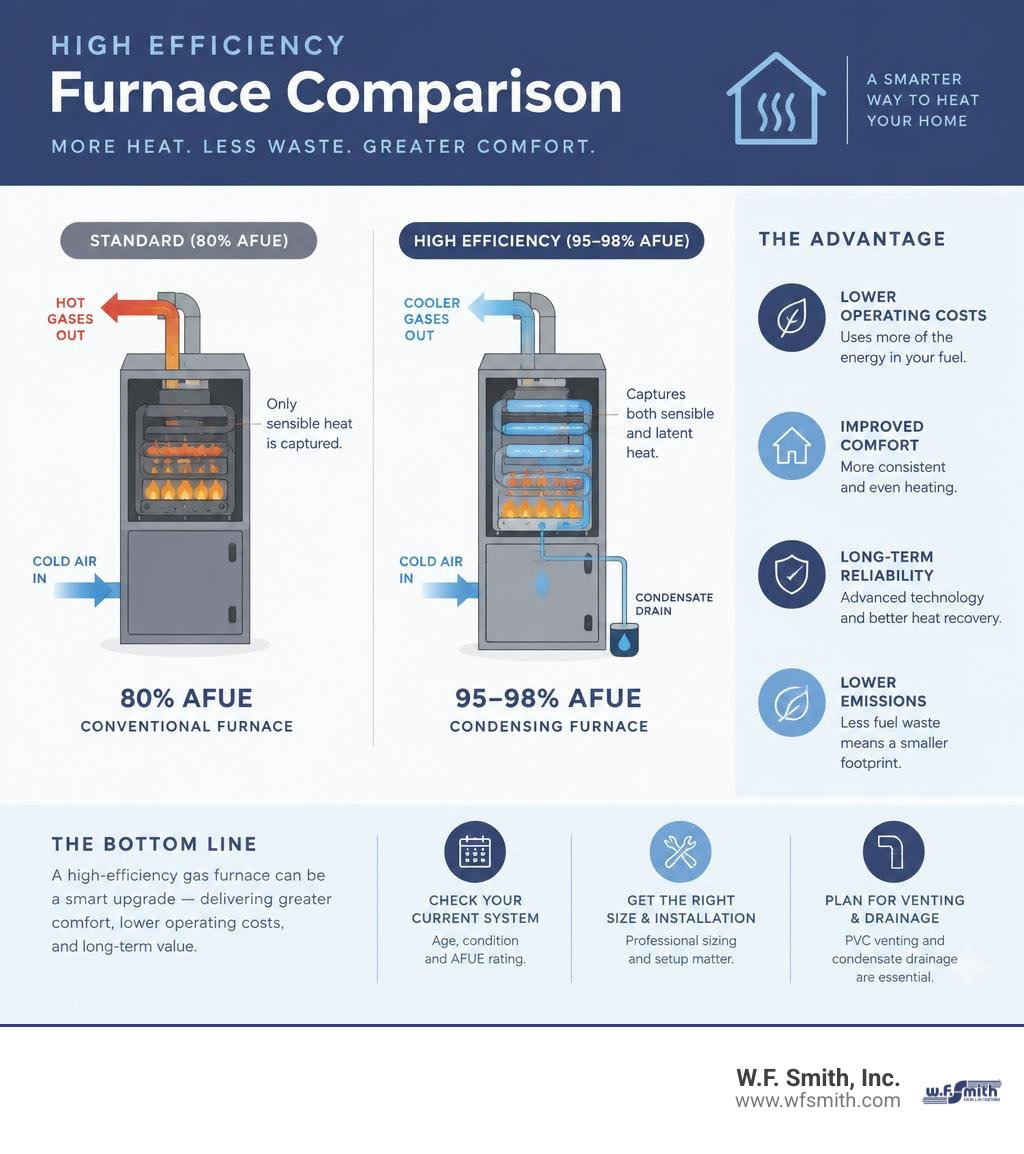
For many Newtown homeowners, a high-efficiency gas furnace is worth considering when an older furnace is costly to run, unreliable, or nearing replacement. Modern condensing models commonly deliver 95% to 98% AFUE, meaning far less fuel energy is lost through the vent than with an older 80% AFUE unit.
The best value depends on three things:
- Your current furnace’s age, condition, and AFUE rating
- Correct furnace sizing and professional installation
- Whether your home can accommodate PVC venting and condensate drainage
High-efficiency gas furnaces use a second heat exchanger to pull additional heat from exhaust gases. This process cools the exhaust enough to capture heat from water vapor that a standard furnace sends outside. The result is lower fuel waste, but these systems require proper drainage, venting, and annual maintenance.
In this roundup, we compare leading high-efficiency furnace options and explain the features that matter most for comfort, operating costs, and long-term reliability in the Philadelphia area.
Engineering Behind High Efficiency Gas Furnaces: Condensing Technology Explained
To understand why modern heating systems achieve strong performance, it helps to focus on the heat-recovery process inside the furnace. High-efficiency gas furnaces use a secondary heat exchanger to capture additional heat from exhaust gases before they leave the home.
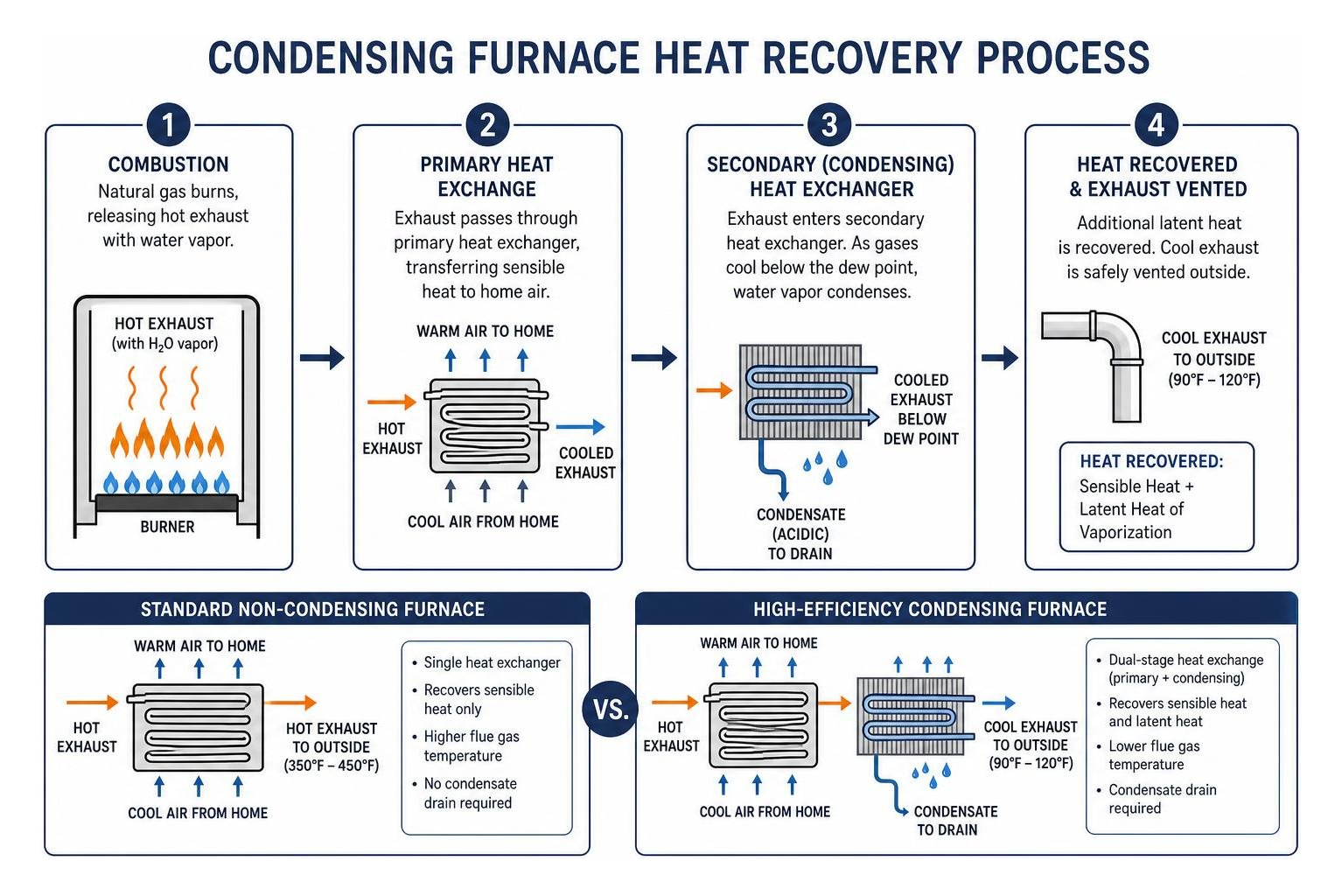
Traditional heating equipment captures only sensible heat, or energy that causes a direct temperature change. In conventional atmospheric furnaces, combustion gases exit the heat exchanger at temperatures well above 350°F to prevent moisture from condensing in metal chimneys. This process wastes substantial energy through chimney losses. High-efficiency condensing units, by contrast, capture both sensible heat and latent heat. Latent heat is released when water vapor, a natural byproduct of natural-gas combustion, changes from a gas to a liquid.
By adding a secondary condensing stage, modern units reduce flue-gas temperatures to below 120°F and recover heat that would otherwise escape outdoors. That added recovery is why understanding how AFUE affects heating costs can help Newtown homeowners compare a new system with an older furnace.
| Metric / Component | Standard Non-Condensing Furnace | High-Efficiency Condensing Furnace |
|---|---|---|
| AFUE Rating | 80% | 95% to 98% |
| Heat Exchanger Stages | Single primary stage | Dual-stage: primary plus secondary condensing |
| Heat Types Recovered | Sensible heat only | Sensible heat plus latent heat |
| Flue Gas Exit Temp | 350°F to 450°F | 90°F to 120°F |
| Venting Material | Category I metal B-vent chimney | Category IV sealed PVC, CPVC, or polypropylene |
| Byproduct Drainage | None; moisture stays vaporized | Acidic liquid condensate drain line required |
Secondary Heat Exchangers and Latent Heat Recovery
The secondary heat exchanger is central to high-efficiency operation. After combustion gases transfer heat to the circulating household air in the primary heat exchanger, they pass through the secondary exchanger for additional heat recovery.
As exhaust gas cools past its dew point, moisture condenses on the heat-exchanger surfaces and releases additional heat. The resulting condensate is mildly acidic, so the components and drain system must be designed to handle moisture safely over years of operation.
Multi-Stage Combustion and Variable-Speed ECM Motors
Modern performance is not just about heat exchangers. It also depends on airflow and combustion management. Older gas furnaces typically use a simple single-stage design, meaning they are either fully on or fully off. Many high-efficiency models use modulating gas valves and variable-speed electronically commutated motor (ECM) blowers.
Modulating gas valves adjust the burner output across a range of capacities. Paired with an ECM blower that can respond to changing duct conditions, the system can run longer and more quietly at lower output. This can reduce temperature swings, lower electrical use, and support more consistent comfort.
Top High-Efficiency Gas Furnace Models Evaluated
When comparing modern heating equipment, look beyond the AFUE rating. Condensing heat exchangers, variable-speed airflow, and compatible controls can all affect comfort and operating performance. W.F. Smith’s gas furnace options give homeowners a starting point for comparing equipment suited to residential installations.
98% AFUE Variable-Speed Modulating Gas Furnace
This flagship design represents the upper end of residential efficiency, achieving up to 98% AFUE.
- Combustion and airflow: Features a fully modulating gas valve paired with a variable-speed ECM blower motor. It can support steadier winter heating and help manage indoor humidity when paired with compatible cooling equipment.
- Smart diagnostics: Communicating capability through an advanced system control can provide two-way digital communication, diagnostics, and comfort adjustments.
- Dual-fuel ready: Can integrate with an electric heat pump to create a hybrid heating system that switches between gas and electricity based on outdoor conditions.
98% AFUE Modulating Gas Furnace
This ultra-high-efficiency system is designed for precise load matching and quiet operation.
- Modulation increments: The burner adjusts output in small increments to better follow the home’s heating load and avoid unnecessary energy use.
- Climate customization: Some systems allow installers to tailor operating settings to the home’s climate and comfort needs.
- Robust construction: An insulated cabinet can help reduce operating noise while directing heat into the supply-air system.
For homeowners considering premium equipment with similar modulating capabilities, other systems can achieve 97% AFUE with broad firing ranges and integrated smart-home communication.
95% AFUE Ultra-Low-NOx Gas Furnace
For applications where lower emissions are a priority, this platform offers a blend of high efficiency and reduced emissions.
- Environmental performance: Achieves a 95% AFUE rating while using low-NOx burners designed to reduce nitrogen oxide emissions.
- Advanced commissioning: Some models offer app-based diagnostics that can streamline setup for qualified technicians.
- Airflow management: A constant-CFM variable-speed motor can compensate for changing duct static pressure and help maintain consistent airflow.
A properly matched system matters as much as the model itself. Our furnace installation service helps homeowners select, size, and install equipment for their home’s heating needs.
Thermodynamic Performance, Modeling, and Design Trade-offs
Engineering a high-efficiency heating system requires balancing heat-transfer performance, airflow, and long-term reliability. Manufacturers use testing and design modeling to evaluate how heat exchangers, combustion controls, and blower systems perform under changing operating conditions.
Thermal performance evaluation considers combustion, heat transfer in the primary and secondary heat exchangers, and condensate formation in the condensing stage. These factors help manufacturers refine the equipment, but homeowners benefit most from choosing a furnace that is properly sized and professionally installed.
Key Efficiency Metrics for High Efficiency Gas Furnaces
Understanding how high-efficiency equipment is rated requires examining a few practical metrics:
- AFUE (Annual Fuel Utilization Efficiency): The standard seasonal rating that estimates how much of the fuel a furnace converts into usable heat over a typical year.
- Thermal efficiency: A steady-state measure of how effectively the furnace transfers fuel energy into heated air.
- Airflow and combustion control: Correct airflow and an appropriate air-fuel ratio support safe, dependable operation.
- High-altitude deration: At higher elevations, equipment may need adjustments because thinner air changes the available oxygen for combustion.
Before selecting a replacement, calculating the appropriate BTU and AFUE ratings can help homeowners connect equipment efficiency with their home’s actual heating load.
Design Trade-Offs in Multi-Stage Heat Exchanger Engineering
Achieving 98% AFUE involves specific mechanical trade-offs:
- Surface area versus static-pressure drop: More heat-exchanger surface area can improve heat recovery, but it can also increase resistance that the blower must overcome.
- Condensate management versus corrosion: Condensing operation recovers additional heat but produces acidic condensate, requiring corrosion-resistant materials and reliable drainage.
- Draft control versus cost: Modulating burners may require more advanced inducer motors and controls to maintain safe exhaust flow at different firing rates.
When major furnace components begin to fail, these signs it may be time for furnace replacement can help homeowners decide whether repair or replacement makes more sense.
Sizing and Installation Requirements for High Efficiency Gas Furnaces
A high-efficiency furnace cannot perform to its rated specification without proper installation and site preparation:
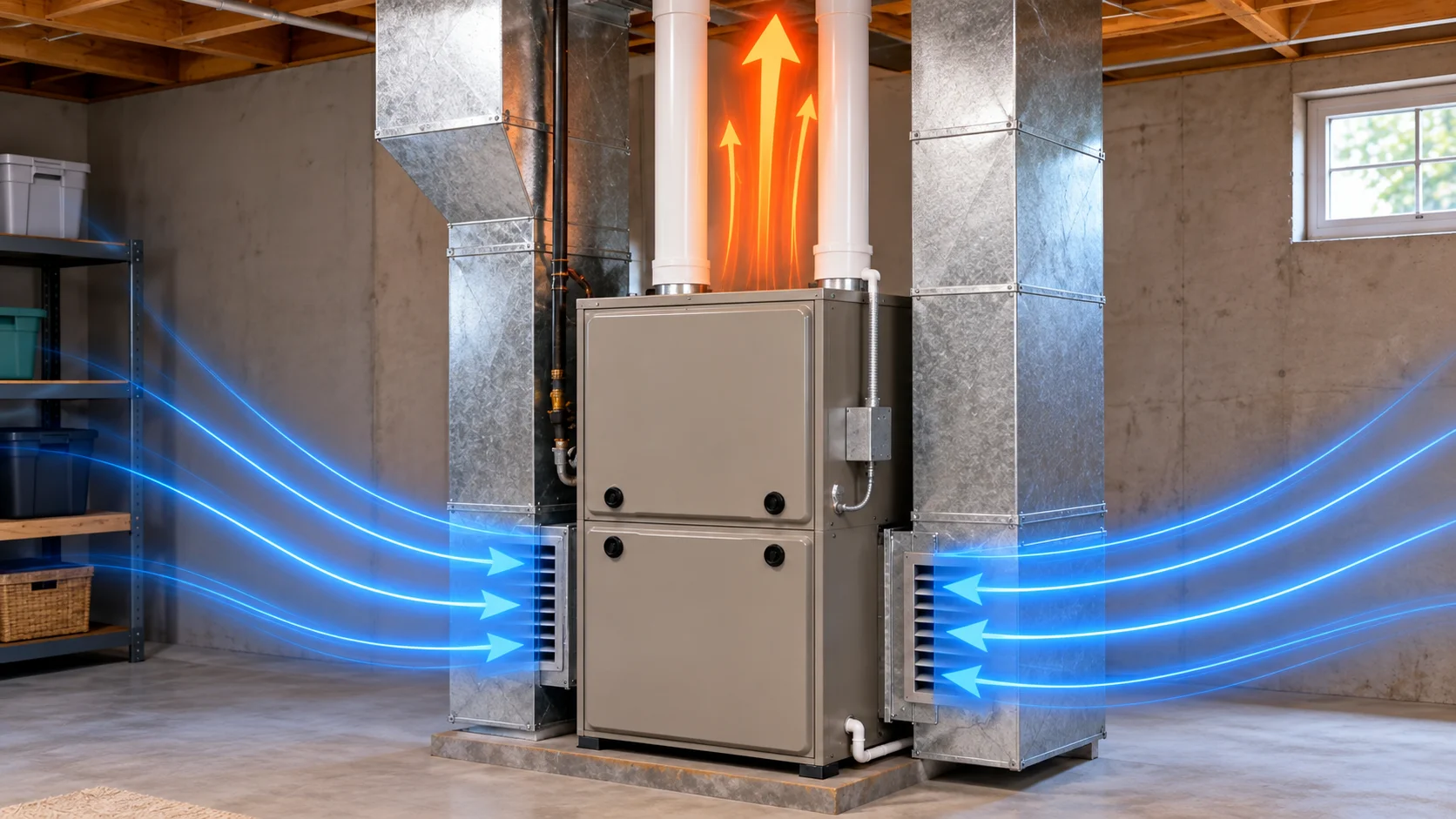
- Direct venting: High-efficiency furnaces require dedicated Category IV PVC, CPVC, or polypropylene venting because their lower exhaust temperatures can create condensation in unsuitable vent materials.
- Concentric vent terminations: Pipe-in-pipe kits can combine combustion-air intake and flue exhaust at one wall or roof penetration while keeping the two air paths separate.
- Condensate drainage: A 95% or higher AFUE furnace produces condensate that must be trapped, drained, and, where required, neutralized in accordance with local requirements.
- Accurate Manual J load sizing: Oversizing can cause short cycling and keep a modulating furnace from operating efficiently at lower output.
During a professional furnace installation process, proper venting, drainage, and startup settings help protect performance from day one.
Knowing why accurate furnace sizing matters can also help homeowners avoid comfort issues and unnecessary operating costs.
For a balanced view of the investment, the pros and cons of high-efficiency furnaces explain when the upgrade is likely to make sense.
Frequently Asked Questions About High-Efficiency Heating Systems
How much can a 98% AFUE furnace save on annual utility bills compared to an older 80% model?
Upgrading from an older 80% AFUE furnace to a 98% AFUE modulating system provides an 18% absolute efficiency increase, which translates to a roughly 20% to 22% reduction in annual natural gas consumption.
For an average home in Newtown, PA burning $1,400 to $1,800 in heating fuel each winter, this upgrade saves approximately $280 to $400 annually in operating costs. Over a typical 15- to 20-year equipment lifespan, especially when accounting for utility rate inflation, the cumulative fuel savings can offset a substantial portion of the initial equipment upgrade investment.
Why do high-efficiency condensing furnaces require dedicated PVC venting and drain lines?
High-efficiency systems extract so much thermal energy from the combustion process that the exiting flue gas drops to between 90°F and 120°F. At these low temperatures, exhaust gases lack the thermal buoyancy required to rise naturally through a vertical metal chimney.
Furthermore, cooling the flue gas below its dew point forces moisture to condense into a mildly acidic liquid. Standard metal vents would corrode rapidly under these conditions. High-efficiency furnaces use dedicated mechanical inducer fans that safely push low-temperature exhaust through sealed, corrosion-proof Category IV PVC, CPVC, or polypropylene pipe, while capturing and draining the liquid byproduct through dedicated drain traps.
Can a high-efficiency gas furnace integrate with a heat pump for hybrid heating?
Yes. High-efficiency gas furnaces pair seamlessly with electric heat pumps in dual-fuel (hybrid) configurations. In a dual-fuel setup, an electric heat pump provides highly efficient heating during mild outdoor conditions (above 35°F to 40°F), where its Coefficient of Performance (COP) delivers lower operating costs than burning gas.
Conclusion: Making the Right Heating Investment in Newtown, PA
Investing in a modern, high-efficiency condensing gas furnace can reduce fuel waste, support quieter operation, and provide more even temperatures during cold Pennsylvania winters. Secondary heat recovery, modulating combustion, and variable-speed airflow can help the right system deliver dependable home comfort.
The W.F. Smith team brings 80 years of experience serving Philadelphia and Bucks County homeowners, along with 24/7 emergency service and a 100% satisfaction guarantee. To discuss whether a high-efficiency furnace fits your home’s layout, budget, and comfort goals, contact our professional furnace technicians.

W.F. Smith was great. They worked very professionally and neatly. They were extremely knowledgeable about the equipment and all specific HVAC practices. Would recommend them to the world!