What BTU and AFUE Should Your New Furnace Have?

A silver, double-stage gas furnace sits in the basement of a home, next to a trash can and a wooden door.

Heating systems are the unsung heroes of our homes, working quietly in the background to keep us comfortable. Most homeowners only think about their furnace when it stops working or when utility bills start creeping up.

When that time finally comes, you will likely encounter a confusing alphabet soup of acronyms and technical ratings. Two of the most critical metrics you will encounter are BTU and AFUE. Understanding these terms is the key to selecting a system that fits your specific needs. We’ll break down exactly what BTU and AFUE your new furnace should have so you can make a confident, informed decision.

Understanding the Basics of BTU

Before you can determine the size of the furnace you need, you have to understand how heat is measured. BTU stands for British Thermal Unit. In technical terms, one BTU represents the amount of heat energy required to raise the temperature of one pound of water by one degree Fahrenheit.

Think of BTUs as the horsepower of your heating system. A higher BTU rating means the furnace can generate more heat. You can usually find this number on the manufacturer’s plate on your current unit. It is typically the middle number in the model sequence, representing thousands of units. For example, you might see numbers like 040, 080, or 120, which correspond to 40,000, 80,000, and 120,000 BTUs, respectively.

Why Bigger Isn’t Always Better

A common misconception among homeowners is that getting the biggest furnace possible is the safest bet. However, an oversized furnace can cause more problems than it solves. If your furnace produces too many BTUs for your square footage, it will heat the space too quickly and shut off. This process, called short cycling, puts excessive wear and tear on components, leading to premature breakdowns.

Conversely, a unit with too low a BTU rating will run constantly as it struggles to reach the temperature set on your thermostat. This results in a cold house and high energy bills. The goal is to find the “Goldilocks” size that is just right for your home.

Factors That Influence BTU Requirements

Finding that perfect number involves more than just looking at your home’s square footage. An HVAC professional will perform a load calculation that considers several variables.

They look at the insulation levels in your attic and walls, the quality and number of windows you have, and even the height of your ceilings. If you have recently upgraded your insulation or sealed drafty windows, you might actually need fewer BTUs than your old furnace provided.

A dark gray, energy efficient furnace with tubing attached sits in the basement, on top of a gray, cemented floor.

Decoding the AFUE Rating

While BTU measures power, AFUE measures efficiency. AFUE stands for Annual Fuel Utilization Efficiency. It is a percentage that tells you how much of the fuel your furnace burns is actually converted into usable heat for your home, versus how much is wasted and vented out as exhaust.

Imagine you spend a dollar on natural gas. If your furnace has an AFUE rating of 80%, eighty cents of that dollar goes toward heating your living room, while twenty cents goes up the chimney. If you have a high-efficiency unit with an AFUE of 96%, only four cents is wasted.

The Minimum Standards

The Department of Energy sets minimum efficiency standards for furnaces. Currently, the lowest AFUE rating allowed for new furnaces is 80%. These units are standard-efficiency models.

They are generally less expensive to purchase upfront, but cost more to operate over time because they waste more fuel. Older units in many homes likely have ratings well below 80%, meaning a replacement will provide immediate efficiency gains.

High-Efficiency Options

Furnaces with an AFUE rating of 90% or higher are considered high-efficiency units. The most efficient models available today are condensing furnaces. These units use a secondary heat exchanger to pull extra heat from the exhaust gases before they leave your home. While the initial price tag is higher, the monthly savings on utility bills can be substantial over the life of the system.

Matching Efficiency to Your Climate

Your geographic location plays a massive role in determining which efficiency rating makes financial sense for you. The return on investment for a high-efficiency furnace depends heavily on how much you use it.

Considerations for Colder Climates

If you live in the Midwest or the Northeast, where winters are long and brutal, your furnace runs constantly. In these regions, the gap between an 80% AFUE unit and a 96% AFUE unit translates to a large difference in annual heating costs. The energy savings you accumulate month over month will likely pay for the higher upfront cost of the high-efficiency unit relatively quickly.

Considerations for Milder Climates

Homeowners in the South or regions with mild winters face a different calculation. If you only run your heat for a few weeks a year, it will take much longer to recoup the extra cost of a top-tier, high-efficiency model. In these scenarios, an 80% AFUE furnace might be the more economical choice overall.

A close-up of a person's hands wearing a smart watch as they replace the filter in the furnace near the ceiling.

Hybrid Systems and Heat Pumps

Another factor changing the conversation about furnace efficiency is the rise of heat pumps. A heat pump can heat and cool your home, transferring heat rather than creating it. Many homeowners are opting for dual-fuel systems, which pair a heat pump with a gas furnace.

In this setup, the heat pump handles heating during moderately cold weather, making it highly efficient. The gas furnace only kicks in when the temperature drops below freezing. Because the furnace runs less frequently in a hybrid system, you might not need the highest possible AFUE rating to maintain an efficient home.

Making the Final Decision

Understanding what BTU and AFUE your new furnace should have involves balancing upfront costs against long-term savings and comfort. A unit with a high AFUE rating and the correct BTU output will lower your carbon footprint and your overall monthly bills. On the other hand, a standard unit might fit a tighter immediate budget if you live in a temperate zone.

There is no single number that works for every house. The insulation in your walls, the layout of your rooms, and the severity of your local winters all change the equation. Therefore, you should always consult with a certified HVAC dealer who can run the proper calculations for your home.

Are you looking for a reliable, expert furnace installation contractor to handle your home’s heating needs? Look no further than W.F. Smith! With decades of experience and a reputation as trusted professionals in the industry, we’re dedicated to providing top-notch service and ensuring your home stays warm and comfortable year-round. Let us help you find the perfect solution for your heating system. Reach out to our team today!

8 Ways To Lower Your Home’s Winter Heating Bill

A man wearing a yellow shirt, a gray beanie hat and scarf sits cross-legged on the floor, feeling cold.

As winter approaches, the thought of a warm, cozy home is a welcome one. What’s less welcome is the high heating bill that often comes with it. Many homeowners resign themselves to expensive utility costs during the colder months, but it doesn’t have to be that way.

There are practical and effective strategies you can use to reduce your energy consumption without sacrificing comfort. Read on for eight ways to lower your home’s winter heating bill so that you can stick to your budget with no stress.

Program Your Thermostat for Savings

One of the easiest ways to control your heating costs is by managing your thermostat effectively. You can set different default temperatures for specific times of the day with a smart thermostat so that you’re not heating an empty house.

Consider a Smart Thermostat

A smart thermostat takes this concept a step further by learning your household’s patterns and automatically adjusting the temperature. Many can be controlled remotely from your smartphone, which gives you the flexibility to make changes on the fly.

For instance, if you’re coming home earlier than expected, you can turn up the heat from your phone so that the house is warm when you arrive. This level of control prevents energy waste and maximizes comfort.

Seal Air Leaks Around Your Home

If you notice drafts from windows, doors, and other gaps, don’t ignore them. Drafts from windows, doors, and other gaps can let a surprising amount of cold air inside, leading to discomfort. Locate and seal these air leaks to improve your home’s overall energy efficiency.

Inspect Windows and Doors

Check the weatherstripping around your doors and windows. If it’s worn, cracked, or missing, replace it. For a quick fix, you can apply temporary caulk or use draft stoppers at the base of doors. On a windy day, you can often feel where drafts are coming from just by holding your hand near window frames and door jambs.

Check for Other Leaks

Air can also leak through less obvious places, like electrical outlets, attic hatches, and gaps around pipes. Use caulk to seal small gaps and expanding foam to seal larger ones. Sealing these leaks is a small project that provides immediate benefits by keeping the heated air inside your home where it belongs.

A woman wearing a black puffer jacket and white hat sits next to the heater of a home while making a phone call.

Use Your Curtains and Blinds Strategically

Your windows can be a source of heat loss, but they can also be a source of free heat. Managing your window coverings throughout the day can help you regulate your home’s temperature without touching the thermostat.

Let the Sunshine In

During the day, open the curtains whenever you can to warm up your home naturally. Passive solar heating can reduce the work your furnace has to do. It’s a simple, no-cost way to harness the sun’s energy.

Cover Up at Night

After the sun sets, close your curtains for that extra layer of protection from the outdoor cold. This helps trap the day’s warmth, keeping you comfortable throughout the season. Thermal curtains are particularly effective for this, as they are designed to minimize heat transfer.

Check and Replace Your Furnace Filter

Neglecting your furnace filter can restrict your airflow, making your HVAC work harder. Regularly checking and replacing your filter is a simple maintenance task that has a big impact on your system’s efficiency and heating bills.

Most filters should be checked monthly and replaced at least every three months. The exact frequency depends on the type of filter and factors like whether you have pets.

Ensure Your Vents Are Clear

For your heating system to work effectively, air needs to be able to circulate freely throughout your home. Blocked vents can disrupt airflow, leading to uneven heating and wasted energy.

Walk through your home and check that all your heating vents are open and unobstructed. Furniture, rugs, and curtains can often block vents without you realizing it. Keeping them clear allows warm air to be distributed properly, helping your home heat up faster and more evenly.

An HVAC Technician wearing a white hard hat, shirt and gloves replaces the system's filter with a new one.

Lower Your Water Heater Temperature

Your water heater accounts for a portion of your home’s energy use. Many water heaters are set to 140°F by default, but for most households, 120°F is sufficient. Lowering the temperature can reduce your water-heating costs without affecting your daily routine.

This small adjustment also slows mineral buildup and corrosion in your water heater and pipes. It’s a simple step that saves money and extends your appliance’s lifespan.

Add More Insulation

Proper insulation is critical for keeping your home warm in the winter. Without it, heat will escape through your walls, attic, and floors, no matter how hard your furnace works.

Focus on the Attic

Since heat rises, the attic is one of the most important areas to insulate. Check your attic’s insulation levels. If you can see the floor joists, you likely need to add more insulation. Adding insulation to your attic is one of the most effective ways to reduce heat loss and lower your energy bills.

Insulate Other Areas

Walls, crawl spaces, and basements are other areas where adding insulation can be beneficial. Proper insulation creates a thermal barrier that keeps your home warmer in winter and cooler in summer, providing year-round energy savings.

Dress for the Weather, Even Indoors

A simple behavioral change can also contribute to savings. Instead of cranking up the thermostat when you feel a chill, try putting on a sweater or using a blanket. It’s an old-fashioned tip, but it works.

By dressing in warmer layers, you can comfortably set your thermostat a few degrees lower. Each degree you lower the thermostat can save you a percentage on your heating bill, and those savings add up over the course of the winter.

Prepare Your Home for Winter Savings

By implementing these eight ways to lower your home’s winter heating bill, you can enjoy a comfortable season without the stress of high energy costs. From simple habit changes to strategic home improvements, every action contributes to a more efficient and affordable home.

If your furnace isn’t performing optimally or is showing signs of age, consulting a professional is a wise step. For unparalleled expertise and reliable service, we invite you to connect with a qualified furnace installation contractor at W.F. Smith. We are dedicated to ensuring your comfort and helping you achieve tremendous savings throughout the winter season. Give us a call today!

What You Should Know About the Furnace Installation Process

What You Should Know About the Furnace Installation Process

When the chill of winter begins to creep through your home, having a reliable heating system is essential to enhance the quality of your space. A critical component of this system is the furnace, which offers refuge from the cold with its warmth and comfort.

Those considering a new furnace will find the installation process to be a complex but manageable endeavor, especially with the different types available. This guide on what you should know about the furnace installation process will ensure a smooth transition to your new heating system.

Choosing the Right Furnace

The initial step in the furnace installation process is selecting an appropriate model for your home. This involves considering the size of your house, your climate, energy efficiency ratings, and your budget. Consulting with professionals to make an informed decision is vital since the right furnace will provide maximum efficiency and comfort for years to come.

Preparing for Installation

Once you select the perfect furnace, preparing your home for installation is the next step. Ensure the area around your current furnace is clear. This involves removing any flammable materials and ensuring there is enough space for technicians to work safely. You might also need to assess your home’s electrical and gas lines to make sure they can accommodate your new system’s requirements.

The Installation Process

Professional furnace installation services are essential to safely and correctly installing your new heating system. Skilled technicians will handle the removal of your old furnace, taking care to dispose of it following local regulations. They will then install your new furnace, connect it to existing ductwork, electrical supplies, and gas lines, and ensure everything functions correctly with proper sealing.

Testing and Quality Assurance

After the physical installation comes a thorough testing phase. Technicians will run the system, monitor its operation, check for leaks or irregular noises, and verify that the thermostat is communicating effectively with the new furnace. This phase is critical to confirm that your new heating system operates safely and efficiently.

Maintenance and Care

Understanding the maintenance practices required to keep your furnace in peak condition is crucial. This typically includes replacing filters regularly, scheduling annual inspections, and being attentive to unusual burning smells or sounds like bangs, knocks, or booms because these indicate problems. Proper care extends the life of your furnace and helps maintain its efficiency.

The process of installing a new furnace in your home requires attention to detail, careful planning, professional assistance, and ongoing maintenance. By gaining knowledge about each step of the process, you can ensure your home remains a warm sanctuary throughout the coldest months.

How Long Will My Heating System Last?

In order to make it through the winter every year, you’ll want to make sure that you have a heating system that you can depend on. The last thing you’ll want is for your heating system to break down on you in the midst of some of the coldest temperatures of the year. Knowing when to replace your heating system will help you to avoid such problems.

How Long do Heating Systems Last?

When it comes to something like a furnace or a boiler, you can expect them to last between ten and 15 years. However, these days, newer heating systems are much more effective and efficient, which means that newer heating systems could end up lasting upwards of 25 years. This does depend on how you take care of your heating system.

Maintaining Your Heating System

If you make sure that your heating system is properly maintained, then it’s more likely to last longer. There are a few ways that you can do this.

  • Improve your home’s efficiency – If your home is losing heat, it means that your heating system will have to work extra hard to replace that heat. By eliminating air leaks throughout your house and by taking other measures to improve your home’s efficiency, such as adding better insulation or upgrading old windows and doors to more energy efficient models, you can help keep heat from escaping your home, allowing your heating system to work less. The less it has to work, the longer it will last.
  • Change your filters – Your air filters help to keep your home’s air quality high. Their job is to trap dust and debris, thereby preventing contaminants from circulating throughout your home. However, if the filters get too dirty, they will begin obstructing the air flow throughout your house, which will force your heating system to use more energy to produce more heat, thereby causing unnecessary wear and tear. Check your filters every month and change them every one to three months as needed.
  • Schedule annual inspections – A thorough inspection before winter can help ensure that your heating system is working effectively and efficiently. Professional inspectors will make repairs, clean components and lubricate parts as needed to help keep your heating system working properly for as long as possible.

Signs You Need to Replace Your Heating System

The following are some of the common signs that your heating system is reaching the end of its life and needs to be replaced:

  • Your heating bills are too high – If your heating costs have skyrocketed, it means that your heating system can no longer produce heat efficiently.
  • It’s no longer working effectively – If you’re unable to heat your home effectively or evenly, it could be because your heating system is reaching the end of its lifespan.
  • It’s making strange sounds – Strange, loud sounds are often indicative of broken or damaged components.

To schedule an inspection or to replace your heating system, be sure to contact us at W.F. Smith in Philadelphia and serving the surrounding cities.

10 Signs You Need a New Furnace

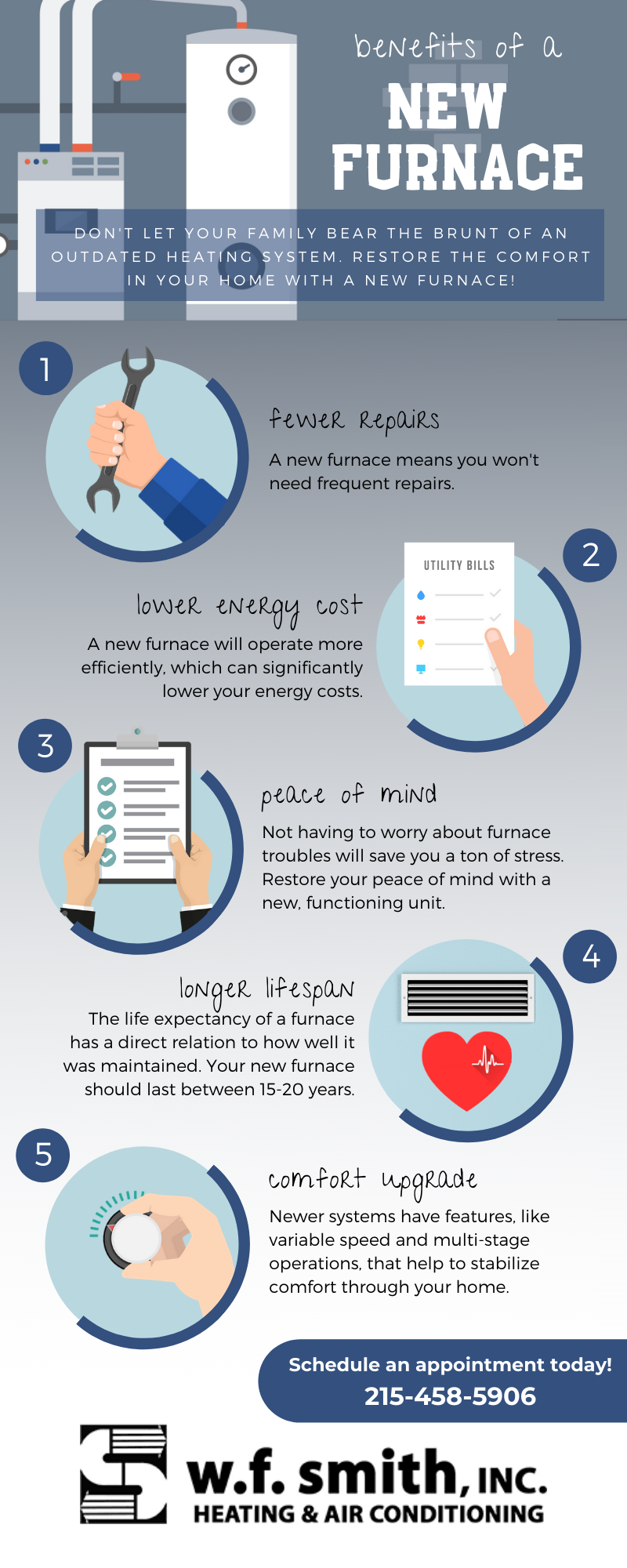
If you have an older furnace you may be wondering if you should give in now or wait it out and see what happens. Sometimes your furnace is trying to tell you something and watching and listening for certain signs can give you a good indication that it is time to replace your old furnace. Once replaced, you and your family will be able to enjoy comfort levels like never before. Check out the infographic below for some essential benefits of getting a new furnace:Benefits of a new furnace

Is Your Furnace Telling You Something?

These 10 signs are a good indication that your furnace is trying to tell you that it is close to the end of its life.

  1. Rising Energy Bills – Rising energy costs can be a definite sign that something is wrong with your furnace. If you have noticed your energy costs rise swiftly your furnace is having to work harder and replacing it may save you a lot of money in the future.
  2. Uncomfortable Home – If your furnace is having trouble keeping up with your home’s heating needs, your furnace may be reaching the end of its life. Replacing your old unit can help keep your home comfortable all winter long.
  3. Excess Repairs – If you are spending a lot of time scheduling repair appointments, your furnace is likely ready to give up the ghost. In the long run you will save money by not having to call for repairs all the time.
  4. Strange Sounds – While some noises can be fixed, squealing and clanging can sometimes occur as your furnace ages. Sometimes a furnace will continue to get louder and louder as it ages.
  5. Yellow Flames – If you have a gas furnace checking the flame can give you a good idea as to what is happening.  If you have a yellow flame instead of a blue flame your furnace may be producing excess carbon monoxide.
  6. Weak Air Flow – If you notice that the hot air coming out of your vents is not very strong your furnace may have major issues with its motor. Sometimes the motor can be repaired but depending on age it may be better to replace the unit.
  7. Excess Dust – If you have noticed more dust in your home your furnace is no longer doing a good job at removing airborne particles.
  8. Rust, Cracks, or Corrosion – If you take a look at your furnace and you notice rust, cracks, or corrosion then for safety reasons you need to have your furnace thoroughly checked. Once these things start occurring your furnace is showing its age and replacement is imminent.
  9. Cycling or Not Cycling – If your furnace is cycling on and off a lot or it just staying on constantly, this is a good sign that your furnace is no longer working correctly
  10. Completely Inoperable – If your furnace is more than 10 years old and it just stops working have someone look at it, it may be an easy fix or it may be trying to tell you something.

Choose W.F. Smith for Furnace Replacement in Philadelphia

A furnace is one of larger investments you’ll make for your home. When doing so, you should trust the professional in charge of the installation. Our team members are not only good at their job, but they excel at it. Check out the video below to see why W.F. Smith should be your go-to when it comes to your HVAC needs:

If you have a furnace that has reached the end of its life, contact the team at WF Smith today for furnace replacement services.